
GS1 Belgilux: Supporting Businesses with Global Standards

Across Belgium and Luxembourg, industries ranging from retail and logistics to healthcare rely on standardized systems to manage product information, follow rules, and compete in global markets. As businesses go digital, clear product identification, easy data sharing, and reliable tracking are more important.
GS1Belgilux (Belgium & Luxembourg) supports this evolution by offering globally recognized standards such as GTINs (Global Trade Item Numbers) and barcodes. These tools empower businesses to work more efficiently, meet regulatory demands, and connect better to global supply chains.
This blog explores how GS1 helps companies adopt global barcode standards, improve product data management, and transition toward advanced 2D barcodes. By doing so, it enhances transparency, boosts trade safety, and optimizes operations across different industries in the region.
Table of Contents
- What is GS1 Belgium and Luxembourg?
- Introduced initiatives and collaborated campaigns
- GS1 Belgilux services for businesses
- Applications of 2D barcodes across industries in Belgium and Luxembourg
- Inspiring Success Stories from GS1 BELU
- Driving Growth with Global Standards in Belgium and Luxembourg
- Frequently asked questions
What is GS1 Belgium and Luxembourg?
Founded in 1978, GS1 Belgilux (BeLu) was first known as the European Article Numbering Association (EAN). It is the Belgian and Luxembourg division of the global standardization organization GS1. It’s the only authorized entity licensed to issue GS1 barcodes and GTINs in its area.
The member organization (MO) provides support for implementing standards for supply chain and product identification globally. It works closely with various stakeholders to ensure GS1 standards are effectively applied across sectors such as FMCG (Fast-Moving Consumer Goods) & food service, Animal & Pet, DIY, fashion, and healthcare.
Its Partner Portal connects companies with certified experts specializing in global standards. It offers an easy-to-use platform to collaborate, access resources, and engage more effectively.
Contact information:
Address: Ravensteingalerij 4 B10, BE-1000 Brussels – Belgium
Contact no: +32 2 229 18 80
Email: support@gs1belu.org
Introduced initiatives and collaborated campaigns
GS1 Belgilux partners with industry stakeholders to promote global standards that support digital transformation and enhance supply chain systems.
GS1 BeLu & Fost Plus
GS1 BeLu works with Fost Plus to make packaging data easier to share. Companies often have to report details about their product packaging, like material type, weight, and if it can be recycled.
Before, this information was sent using separate tools or manual forms. Now, the goal is to let companies enter packaging data once into GS1 systems, then use that same data for Fost Plus reporting. It saves time, reduces typing mistakes, and keeps information consistent.
This information is essential for building a circular economy, an economic model that makes the most of resources and minimizes waste. With EU measures coming into play, pressure on businesses is increasing.
Key regulations like:
Single-Use Plastics Directive (SUP-D): Limits the use of common disposable plastics to reduce pollution and encourages companies to offer better alternatives.
Packaging and Packaging Waste Regulation (PPWR): Sets stricter rules on how packaging is made, reused, and recycled so businesses reduce waste and keep materials in circulation longer.
These types of shifts will push the need for accurate packaging data to grow quickly.
The partnership ensures packaging data is EU‑ready and transparent for businesses and regulators.
Peppol
Peppol (Pan-European Public Procurement Online) helps businesses send and receive electronic invoices across Europe. It makes document exchange simple and avoids local format issues.
The EN 16931 standard sets the rules for invoices, so they are valid and readable in all European countries. Following it reduces mistakes and speeds up payments.
GS1 BeLu helps businesses connect to Peppol. It makes sure invoices meet EN 16931 rules and converts your data into the correct format. This makes setup faster and easier.
For companies using HO2C (High-Level Order-to-Cash), Peppol and GS1 Belu can handle the entire process, orders, invoices, and payments, electronically and smoothly.
With GS1 Belu and Peppol, businesses can send invoices across Europe without headaches, stay compliant, and get paid faster.
GS1 Belgilux services for businesses
GS1 provides tools and services through which businesses can work more productively and innovate across different industries.
Global Data Synchronization Network (GDSN)
GS1 GDSN is a system for product data exchange, allowing companies to easily share trusted, high‑quality product information across markets. When product details are clear and reliable, your business thrives.
It allows businesses to align logistics details, label data, and digital files (such as PDFs, images, or safety sheets) with trading partners globally in a standardized format. It ensures that all users access the same reliable, updated details. It removes the need for each business to store its own copy of product details.
My Product Manager Identify
My Product Manager Identify simplifies product identification by giving businesses an easy way to generate GTINs and barcodes. In just a few clicks, you can create codes, access the matching barcodes, and set your products up for recognition in both physical stores and online marketplaces.
Once you create and manage your GTINs in My Product Manager, your products are instantly available through Verified by GS1. When trading partners request more details, Verified by GS1 allows checking the information stored in My Product Manager.
The yearly subscription (valid for a year; renewed every January) to My Product Manager Identify provides you access to:
- Set up and manage product codes and barcodes
- Generate and control your digital links
- Use My Locations to generate and manage location codes
- Verify product identity through Verified by GS1
- Get support via a trilingual helpdesk, along with access to training and barcode verification services
The tool also supports the GS1 Digital Link standard, transforming product codes into web links for sharing trusted information online. For businesses that need a more customized product page, GS1‑compliant solutions like QR TIGER’s Digital Link QR Code Generator offer that extra flexibility.
My Product Manager Share
With My Product Manager, sharing reliable product information becomes effortless. You can instantly create structured product records, attach files, and exchange precise label details with partners via GS1 GDSN.
The type of data it provides access to includes images, multimedia files, packaging and label details, regulatory and commercial information, logistical data, and core product attributes.
The yearly subscription (valid for a year; renewed every January) to My Product Manager Share helps you access the following features:
- Share labels, product info, and digital assets with partners in all markets.
- Conduct real‑time checks with builtin data quality reporting.
- Direct access to the GDSN network.
- Get support from a trilingual helpdesk.
- Learn more with specialized GS1 training.
The service also supports the GS1 Digital Link standard through which product identifiers convert into web links for smooth access to trusted product data. If your business needs a more customized product page then you can use tools like QR TIGER’s Digital Link QR Code Generator.
Verified by GS1
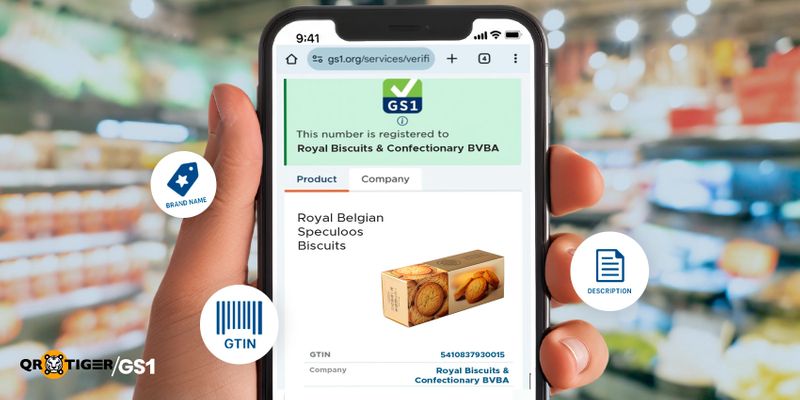
Verified by GS1 is a centralized global system that checks GTINs and core product data, but the information comes from each local GS1 Member Organization.
This means users can confirm whether a product is valid anywhere in the world, while the data reflects the company and product details maintained by the local GS1 office.
Once a product code (GTIN) is typed in, the platform shows which company owns the product code and lists the basic details tied to that product, giving users a clear and dependable view of what the item is.
It also checks if license data and identification key details match the information in your system, ensuring accuracy and trust across the supply chain.
For brands in Belgium and Luxembourg, Verified by GS1 makes product validation simple. Any product carrying a GS1 Belgilux company prefix (starting with 54) that is uploaded in My Product Manager (whether directly or through GS1 GDSN) is automatically added to the GS1 Registry Platform.
GS1 EDI
GS1 Electronic Data Interchange (EDI) makes it easy to share commercial, logistics, and financial data with partners automatically. Instead of relying on manual documents like emails or paper forms, EDI lets you send orders, delivery notes, and invoices quickly and with minimal effort.
It benefits in the following ways:
- Clear identification of products and locations
- Fewer errors
- Improved stock control
- Shorter delivery times
- Stronger traceability across the supply chain
From 1 January 2026, Belgian VAT‑liable companies must issue and receive standardized e-invoices through the Peppol network. This e-invoicing law requires all businesses to switch over together, not in phases. It applies to all B2B invoicing between companies established in Belgium, with limited exceptions.
These invoices must comply with the European Norm (EN 16931-1:2017+A1:2019).
GS1 Belgilux supports two e-invoice formats:
- Peppol
- Harmonised Order to Cash (HO2C v3, UN/EDIFACT D01B EAN11)
Other services
My Coupon Manager: This tool encodes and distributes coupon data in a standardized way to automate coupon handling at checkout. Retailers can instantly verify whether the promoted products have been purchased, while the system also supports the clearing process.
It ensures that discounts are reimbursed to retailers and billed correctly by the coupon issuer. Coupon validation is standardized across the market, ensuring promotions are simpler to handle and more effective for both retailers and businesses.
My Data Capture: To simplify managing product data in GS1’s My Product Manager, GS1 offers My Data Capture. It is a service that helps businesses correctly register and share product information without needing specialized knowledge.
It is designed for companies producing and selling FMCG (both food and non‑food), as well as pet food. Typical examples include packaged foods, cosmetics, cleaning products, and pet food.
With My Data Capture, GS1 experts ensure your product information is accurate from the start. Using AI, they capture details directly from your labels, enter them correctly into My Product Manager, and allow sharing with retailers, online marketplaces, apps, and consumers.
Audit Program: The GS1 Audit Program makes sure product data on packaging matches the data in the GS1 system. It checks that information is correct, consistent, and follows GS1 standards. It aims to prevent mistakes, build trust, and keep product data fully accurate.
This leads to better inventory management, smoother operations, and an enhanced customer experience.
Applications of 2D barcodes across industries in Belgium and Luxembourg
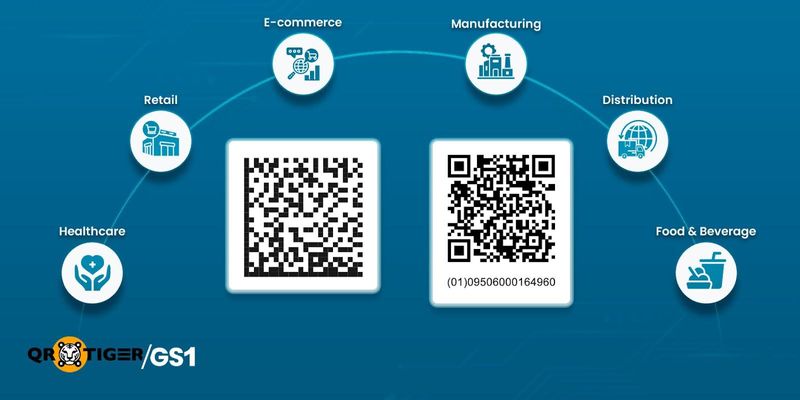
By 2027, retail will move to 2D barcodes, offering more data than traditional 1D codes. This simplifies product tracking and gives customers richer information.
The change is part of the GS1 Sunrise 2027 initiative, a global initiative to improve shopping experiences. It’s not mandatory for all industries; those outside the scope of the EU Digital Product Passport (DPP)can still use 1D barcodes.
Many businesses are preparing with dual marking, adding both 1D and 2D barcodes to packaging to stay compatible now and ready for the future.
Preparing for Sunrise 2027 is simple. Brands can generate GS1‑compliant 2D barcodes on their own by following GS1’s official guidelines or use trusted tools like QR Tiger’s GS1 QR code generator.
External solutions are useful for teams with limited resources, providing a quick and efficient path to integrate next-generation barcodes. They ensure the shift is seamless, cost‑effective, and future‑proof.
Here are some of the key applications of these codes across industries in Belgium and Luxembourg:
Retail
Retailers are adopting 2D barcodes to provide consumers with richer product information directly at the point of sale (POS). They can store information such as ingredients, allergens, certifications, recycling instructions, etc., which are increasingly demanded by regulators and shoppers. This supports transparency and enhances consumer trust.
For example, a consumer can scan a GS1 Digital Link QR code from a smartphone to connect directly to a web page with verified product information.
When a 2D barcode is scanned at the retail POS, it instantly shares key details (such as GTIN, price, batch/lot number, expiry date, and other logistics details). This benefits retailers from faster checkouts, fewer errors, and improved stock visibility.
Healthcare
Hospitals and pharmacies use GS1 DataMatrix barcodes to ensure patient safety and regulatory compliance. These barcodes can encode batch identifiers, serial numbers, and expiry dates, which are critical for medicines and medical devices. This supports traceability and helps reduce counterfeit products from entering the supply chain.
The healthcare sector benefits from optimized inventory management and reduced administrative burden. By scanning a single 2D barcode, staff can access all necessary information, ensuring accurate dispensing and compliance with EU Falsified Medicines Directive requirements.
Food and Agriculture
Food producers and distributors use 2D barcodes to meet growing demands for food traceability and sustainability. These barcodes can encode information about origin, farming practices, and certification details, which consumers can access instantly via smartphones.
Note that this applies only to packaged goods carrying a GTIN. For example, by embedding batch and lot information in QR codes powered by GS1 Digital Link, companies can quickly identify affected products in case of contamination. 2D barcodes thus help reduce recalls and improve supply chain visibility.
Logistics
2D barcodes are transforming warehouse and transport operations in the region. GS1’s Scan4Transport standard is used to optimize logistics operations. It uses the Serial Shipping Container Code (SSCC) that distinguishes every pallet, container, or carton.
Integrating the SSCC into a 2D barcode (on a transport label) transforms each logistics unit into a smart, traceable item. For example, a single scan of a GS1 QR code connects it to the correct shipment record, helping logistics partners access key transport details like destination, handling instructions, and regulatory information.
The process makes sure goods are received faster, and carriers and warehouses operate in sync. It helps stakeholders check shipment status.
Inspiring Success Stories from GS1 BELU
GS1 BeLu empowers businesses to enhance product visibility, safety, and efficiency. These case studies show the role of GS1 standards in improving supply chains.
Medipim
Medipim, a Belgian online platform, supports healthcare professionals and pharmaceutical businesses by offering a database consisting of product images, descriptions, brochures, and more.
Medipim faced the challenge of managing product data across multiple countries, where different numbering systems often led to confusion. By adopting GTINs and integrating the Verified by GS1 tool, the platform ensured every product was correctly linked to the right company, building a reliable and trustworthy database.
The platform now maintains higher data accuracy and can better confirm whether products are still active in the market.
Manna Foods
Manna Foods has been known for its hot and cold sauces for 90 years. In addition to recipes, they also focus on improving product data and digital processes. Their marketing and sales team partnered with GS1 BeLu for a tailor‑made training.
The training was highly interactive and practice‑oriented. It provided the team with tools that helped in the following ways:
- Learn how to review sauce labels and give useful feedback to make them better.
- Looking for a provider to organize and manage master data clearly.
- Check packaging sizes, shapes, and how they are shipped to make sure everything is correct.
With these training sessions, the brand now stands ready to strengthen collaboration, improve data quality, and optimize operations.

Driving Growth with Global Standards in Belgium and Luxembourg
GS1 Belgilux play a crucial role in helping businesses across Belgium and Luxembourg optimize their supply chains through globally recognized standards. Its services encourage companies to track products better, reduce errors, and follow local and international regulations, making trade easier and businesses more competitive.
The member organization collaborates with industry players across sectors to support the move towards modern, transparent, and sustainable supply chains. Joining GS1 gives businesses access to reliable tools and standards that help them grow, build trust, and get ready for future digital changes.
Frequently asked questions
1. What is a GS1 Logistics Label, and what information does it hold?
A GS1 Logistics Label is a sticker placed on logistics units (like pallets or cartons) that carries a unique code called the SSCC. This code acts like an ID card for the unit, making it easy to identify and track.
For homogenous logistics units, a GS1 Logistics Label can include additional information apart from SSCC. It can hold the batch number, expiration date, and the GTIN of the associated unit. The details appear both as a barcode and as plain text that people can read.
2. What is Peppol, and how does GS1 BeLu support e‑invoicing?
Peppol is a global network that lets businesses and public authorities send and receive electronic invoices. It enables automatic sharing of invoices in a standardized format from one system to another, ensuring speed, security, and accuracy.
GS1 BeLu helps companies register with identifiers like GLN to ensure invoices are routed correctly. This reduces manual errors and speeds up financial processes.

DISCLAIMER: We acknowledge that GS1, as well as the materials, proprietary items, and all related patents, copyright, trademark, and other intellectual property (collectively, “intellectual property”) relating to its use, are the property of GS1 Global, and that our use of the same shall be in accordance with the conditions provided by GS1 Global.
