
GS1 Colombia: Standards for Smarter Supply Chains

Colombia’s industries are working towards making supply chains more transparent, meeting regulations, and keeping up with digital commerce. From agriculture and logistics, businesses need product information that is accurate, easy to share, and works across different systems.
GS1 Colombia (CO) supports this transformation by providing globally recognized standards such as GTINs (Global Trade Item Numbers) and barcodes. These tools help companies reduce errors, improve traceability, and align with both local regulations and international trade demands.
This blog explores how GS1 CO helps businesses adopt global barcode standards and drive transparent supply chains.
Table of Contents
What is GS1 Colombia?
Founded in 1988, GS1 CO was first known as IAC Colombia. It is the only authorized entity licensed to issue GS1 barcodes and GTINs in the area. It provides support for implementing and managing GS1 standards, benefitting over 23,000 companies across the country.
The member organization (MO) helps companies share clear information using identification and communication standards. It collaborates with industry partners to improve product efficiency and traceability across the country.
Contact information:
Address: Avenida El Dorado Nº 92 – 32, Módulo G5, Piso 5, 111071, Bogotá, Colombia
Contact no: + 57 1 427 0999
Email: web@gs1co.org
Introduced initiatives and collaborated campaigns
GS1 partners with industry leaders to advance global standards that support digital innovation and build more efficient, connected supply chains.
GS1 CO & the Ministry of Health and Social Protection (MoH)
GS1 CO worked with the MoH to test the use of Unique Device Identification (UDI) for medical devices. The challenge was securing the MoH’s approval and aligning healthcare providers with the proposal.
A public consultation reviewed the draft resolution for a UDI semantic standard. GS1 Colombia, the National Association of Businessmen of Colombia (ANDI), and the National Federation of Merchants (FENALCO) conducted a meeting with the MoH to define how UDI could be implemented to meet government and industry needs.
The objectives of the consultation were to validate UDI‑DI against the MoH’s required semantic standard and compare UDI with existing medical device identification (IDM).
The GS1’s involvement in the adoption of UDI resulted in better information exchange and interoperability among stakeholders using UDI‑DI as a shared standard language. It also contributed to improved patient safety.
Modern Traceability System for Pharmaceuticals
In Colombia, pharmaceutical tracking is fully manual with no validation database, making inspection and traceability extremely difficult or even impossible.
Several stakeholders, together with GS1 Colombia’s Health and Social Security Working Group, are developing initiatives to meet government requirements, the Article 34 of Law 1122 of 2007 by the National Institute of Food and Drug Monitoring.
These efforts focus on product identification, process improvements, and automatic data capture. The goal is to build effective traceability systems based on the following aspects:
Unique identification to ensure every medication is traceable across all stages, from to final consumption.
To provide a secure way to represent identification that keeps data accurate, proves products are genuine, and speeds up processes with automatic capture.
To use an online system that records every product event. It involves tracking what was sent, received, sold, or administered, with quantities, locations, responsible parties, and transport details for complete traceability.
The implementation of the right technology lets events be captured automatically. This gives accurate online information and makes bulk operations run smoothly.
Applications are being developed to allow consumers to access legal product details and additional information on their mobile phones.
GS1 Colombia | LOGYCA for enhanced data quality
Retailers and suppliers are using GS1 Colombia I LOGYCA solutions to ensure accurate product information. The solutions use the Data Quality National Plan to determine the quality required to strengthen the relationship between industry and retailers.
This initiative benefits the retail industry by improving product visibility, keeping attributes updated, and enabling reliable information sharing among partners. It reduces checkout errors, enhances customer service and loyalty, and enhances the shopping experience through smooth omnichannel integration.
GS1 Colombia services for businesses
GS1 offers solutions that boost business efficiency and drive innovation across multiple industries.
Códigos de barras (Barcodes)
GS1 CO provides barcodes that help you sell your products. GS1 barcodes allow you to access new markets, improve logistics, and boost online presence. Barcodes are provided free of charge to a micro or small enterprise (MSE).
Using barcodes gives businesses a unique identity for their products and company, opens more sales opportunities, and strengthens brand recognition. They help optimize processes like inventory, shipping, and purchasing, and provide visibility into product movement
Here are the steps to get barcodes:
1. Go to www.gs1costore.org and select "Códigos de barras" (Barcodes) from the top menu.
2. Choose the type of code you need and the quantity.
3. Click "Comprar" (Buy) and review your cart.
4. Select "Finalizar compra" (Checkout).
5. Log in with your registered email. If this is your first time, select "Registrarme" (Register) and fill out the form.
6. Complete the payment following the indicated steps.
7. You will receive the following in your email:
- The "Oferta mercantil" (Commercial Offer/Sales Offer).
- The access credentials for the ACTIVATE platform where you can manage your barcodes
Excelencia de Datos Premium (Premium Data Excellence)
The service helps keep your product information consistent from source to sales channels. Following GS1 international standards improves efficiency, ensures data accuracy, and builds trust in data sharing.
This service gives your company early visibility to prevent misuse, spaces to collaborate with partners, expert support from a data quality auditor, clear alignment of information, ongoing training, and the opportunity to earn national recognition through the Data Excellence Award.
Verified by GS1
This service confirms whether the GS1 identifiers are valid or not. It enables users to access a single reliable source of product information, known as the GS1 Registry Platform. It helps check whether a product’s identification numbers and barcode align with the GS1 standards.
It enables brand owners to upload their data and merchants to check product listings. It verifies whether a number is properly licensed to a company and whether the registered details match internal records.
Asistencia técnica (Technical support)
Technical support provides personalized training to help you understand and correctly apply GS1 Standards, ensuring their proper use through guidance on international best practices and effective implementation across your processes.
Through training sessions, you will strengthen your knowledge in capturing product attributes, printing barcodes correctly, and applying logistics practices for smoother operations.
Applications of 2D barcodes across industries in the Netherlands
By 2027, retail will enter a smarter age of product labeling with 2D barcodes. These codes go beyond the limits of 1D barcodes. They store richer details that simplify tracking and improve customer engagement.
This evolution is part of the GS1 Sunrise 2027 initiative, designed to make shopping faster and more effective across both digital and physical spaces. For now, the shift is voluntary, and industries may continue with 1D barcodes where regulations allow.
Many companies are using dual barcodes (1D and 2D) on packaging to support existing systems and prepare for future changes.
To gear up for Sunrise 2027, companies can generate GS1-compliant 2D barcodes in two ways: by following GS1’s official guidelines in-house or by using reliable tools like QR Tiger’s GS1 QR code generator.
For companies short on time or technical expertise, these external tools offer a fast and reliable way to generate and apply next-generation barcodes, simplifying the transition to the new standard.
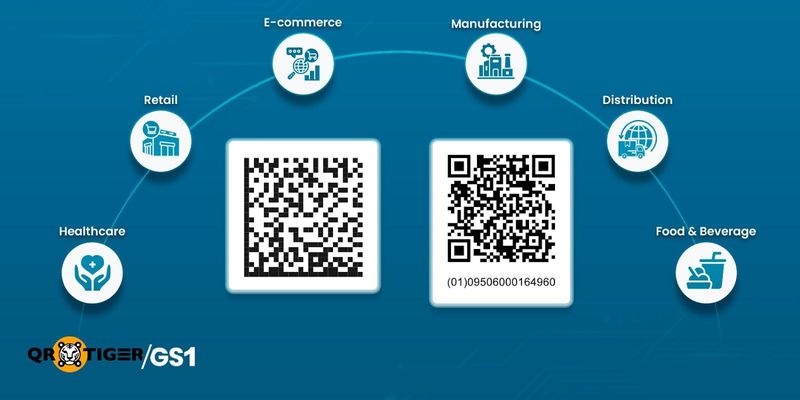
Here are some of the key applications of these codes across industries in Colombia:
Retail
GS1-powered 2D barcodes are used in retail to improve the point of sale (POS) operations and consumer engagement. These 2D barcodes (such as GS1 DataMatrix and GS1 QR codes) can store richer product details (such as ingredients, batch numbers, expiration dates, and even links to digital content).
For example, when a consumer scans a GS1 Digital Link QR code, they can access a web page that shows verified product information. Retailers can use these codes to improve inventory accuracy and strengthen consumer engagement.
Healthcare
The industry adopts GS1 DataMatrix to strengthen patient safety and supply chain integrity. Pharmacies and hospitals can encode critical data (such as serial numbers, batch numbers, and expiration dates) into these compact barcodes.
This supports compliance with international standards, optimizes inventory management, and reduces risks of counterfeit medicines.
Food and Agriculture
2D barcodes support traceability and export readiness in this industry. For example, fruits, vegetables, and other major exports can be packaged and labeled with GS1-compliant 2D codes that capture farm-to-market data.
For example, when consumers scan QR codes powered by GS1 Digital Link, they can verify sustainability. Trade partners and regulars can scan these codes to trust the labeling.
GTINs apply only to packaged goods, but in export sectors like meat, dairy, and horticulture, they ensure reliable traceability.
Distribution
2D barcodes are used in the logistics sector to boost efficiency across transport and warehousing. To simplify logistics and make it more reliable, GS1’s Scan4Transport standard is used. It encodes the Serial Shipping Container Code (SSCC) that helps distinguish carton, container, and pallet.
When the SSCC is encoded into a 2D barcode, for example, a GS1 QR code, printed on a transport label, it becomes easy to scan each logistics unit. Also, it enables linking to the appropriate shipment record.
Scanning these barcodes allows logistic partners to check details such as compliance notes, handling instructions, and delivery addresses. In this way, goods are received faster, and supply chain visibility strengthens.
Inspiring Success Stories from GS1 CO
GS1 has helped businesses from different sectors improve how they track products, ensure safety, and manage operations. These practical success stories show how GS1 standards make supply chains stronger and build trust among consumers.
Cooperativa Nacional De Droguistas Detallistas (Coopidrogas)
Coopidrogas is a non‑profit association supporting independent pharmacies. To maintain a lean and efficient supply chain, Coopidrogas faced three main challenges. First, it needed to keep product information up to date to ensure smooth information flow among independent pharmacies.
Coopidrogas launched a project to apply GS1 standards and strengthen corporate trade using GS1 EDI. This included synchronizing product data and handling electronic transactions.
It ensures reliable data, speeds up time-to-market, and improves information flow across the Coopidrogas value chain. Through GS1’s collaboration with the pharmaceutical sector, the project established key guidelines and shared accurate information and training for stakeholders.
Alexion
Alexion is a global pharmaceutical company focused on rare diseases. It creates innovative treatments that help patients and families live healthier lives. The company had to build a traceability system to meet Colombia’s pilot specifications.
By working with its partner Audifarma, Alexion launched a project to make medicines traceable across the entire supply chain. Starting with Soliris, they built a system that could capture and share key information at every stage.
The initiative moved through five phases: planning, diagnosis, applying GS1 standards, and creating a scanning method to make sure each unit of medicine could be tracked from the factory to patients.
Soliris was given a unique GTIN. This GTIN, along with details like lot number, serial number, and expiry date, was encoded into a GS1 DataMatrix barcode and printed directly on each dose and package.
Once labeled, the medicines were shipped to the distribution center, ensuring complete visibility and reliable traceability throughout the supply chain.
Cruz Verde
Cruz Verde is a major pharmaceutical and healthcare company in Colombia. However, their current system has big issues when delivering medicines to hospitals:
- Hospital staff have to manually check every medicine - lot numbers, expiration dates, etc.
- This takes up to 8 hours and has a 1.5% error rate
- They use Excel spreadsheets instead of automated systems
- There's a 17-20% return rate on pharmacy items
- They can't trace which patient got which specific medicine
Cruz Verde worked with GS1 Colombia to build a proper tracking setup. It moved through three phases.
- Phase 1 – Characterisation: They reviewed the current process, pinpointed the pain points, and listed the key data that needed to be tracked.
- Phase 2 – Identification Model: They chose GS1 DataMatrix as the barcode format and defined what information it should hold. They also planned where the codes would be placed on each product.
- Phase 3 – Data Capture and Transmission: They installed the scanning tools, linked them to their internal systems, and tested the workflow to confirm everything ran smoothly.
The result: The new automatic tracking system uses GS1 DataMatrix barcodes to scan medicine details, trace products from warehouse to patient, and eliminate the slow, error-prone manual process they used before.
Dromayor and Pfizer
Dromayor, a Colombian wholesaler, and Pfizer, a global pharmaceutical manufacturer, successfully launched a pilot project using GS1 standards to build a traceability system across the supply chain.
The project used GTIN, GS1 DataMatrix, and GS1 Global Data Synchronization Network (GDSN).
In the pilot, nine over‑the‑counter medicines were tagged at Dromayor’s distribution center with GS1 DataMatrix codes carrying GTIN, batch details, expiry, and serial numbers. To keep product data aligned, Dromayor used CABASnet, a GS1-certified data pool, and connected its ERP with GS1 Traceability System Online to track serial numbers.
Pfizer uploaded shipment details to the CABASnet system, and Dromayor printed and applied DataMatrix barcode labels to each package. The drug store scanned the GS1 DataMatrix barcode and confirmed receipt in the CABASnet Online Traceability System, ensuring supply chain visibility.
 Advancing Colombian Businesses with Global Standards
GS1 Colombia helps businesses make their supply chains stronger and smarter by using global standards for product identification, data sharing, and tracking. Its services make it easier for companies to follow national regulations, stay transparent, and run operations more efficiently.
By joining GS1, businesses get reliable tools and expert support that help cut errors, improve efficiency, and build customer trust. Working with government bodies and industry associations, GS1 keeps companies in line with global standards. As the country moves toward digital growth, GS1 gives businesses the foundation for smarter supply chains that stay competitive both nationally and globally.
Frequently asked questions
1. How can I check if a barcode is valid?
GS1 offers a tool, ‘Verified by GS1’, to confirm the validity of barcodes. It shows whether the barcode is currently active, verifies that it belongs to a registered company, and ensures it meets GS1 standards.
2. How many barcodes do my products need?
Every variation of a product must carry its own barcode (GTIN). For example, if a clothing brand sells a T‑shirt in three sizes (Small, Medium, and Large) and in two colors (Black and White), each size‑color combination requires a separate GTIN.
It means the Small White T‑shirt, Medium White T‑shirt, Large White T‑shirt, and so on, all need unique barcodes. In this case, the brand needs a total of 6 GTINs.
This ensures that supermarkets, e‑commerce platforms, and inventory systems can correctly identify, track, and sell each specific item without confusion.
3. Are GS1 barcodes compatible with management software?
Yes. GS1 barcodes are built to integrate smoothly with leading systems such as ERP (Enterprise Resource Planning), MES (Manufacturing Execution System), WMS (Warehouse Management System), CRM (Customer Relationship Management), and e-commerce systems.
- Traditional barcodes (UPC, EAN, GS1-128): The barcode carries the GTIN and sometimes additional data like batch or serial numbers. Your system uses this information to look up product details in its own database. The barcode itself doesn’t connect to APIs; it simply acts as a key to retrieve data stored internally.
- GS1 Digital Link (2D barcodes, QR codes): The barcode contains a URL with the product’s GS1 identifiers. Scanning it can trigger a web request to retrieve up-to-date information from online sources or APIs. This allows software to access richer product data in real time, such as supply chain information or instructional content.
Important: For either approach, your software must be configured to read and interpret GS1 standards correctly, including Application Identifiers (AIs), to ensure full compatibility.

DISCLAIMER: We acknowledge that GS1, as well as the materials, proprietary items, and all related patents, copyright, trademark, and other intellectual property (collectively, “intellectual property”) relating to its use, are the property of GS1 Global, and that our use of the same shall be in accordance with the conditions provided by GS1 Global.
