
GS1 QR Codes in Retail Packaging: Why They’re Now a Must-Have

The humble barcode has guided products through checkouts, warehouses, and supply chains for over five decades. It has been, without question, one of the most quietly consequential inventions in modern commerce.
But it was designed for a world that no longer exists: a world of limited computing power, analog print runs, and consumers who simply wanted to pay and leave.
There’s a solution for this: GS1 QR Codes in Retail Packaging. Today's retailers want updated inventory data, recall precision, and seamless omnichannel traceability. Today's regulators are beginning to mandate digital product information at a scale the old barcode was never built to carry.
We will discuss a fundamental reimagining of what a symbol on a package can do. This article explores what they are, why the industry is converging on them, how to implement them effectively, and what the transition means for your brand, your operations, and your customers.
What Are GS1 QR Codes and How Do They Work?
A GS1 QR Code is a two-dimensional barcode that carries structured product data using the globally recognized GS1 standards.
Unlike a simple QR code linking to an arbitrary website, it carries machine-readable identifiers, most importantly the Global Trade Item Number (GTIN) embedded within a standardized web URI called a GS1 Digital Link.
To understand why this matters, consider the gap between the UPC/EAN and GS1 QR Code:
Traditional 1D Barcode (UPC/EAN) | GS1 QR Code (2D) |
Encodes 8–14 numeric digits | Encodes thousands of characters alphanumeric and binary |
Carries GTIN exclusively no batch, expiry, or serial data | Carries GTIN plus batch, lot, expiry, serial number, and more |
Requires a dedicated POS scanner, Checkout only | Scannable in: Retail: inventory and checkout Consumer-facing use: engagement, Regulation: traceability, compliance |
Static data; cannot be updated post-print | The data is static but links to dynamic web content updatable after printing |
Physical damage to the image means scan failure | Reed-Solomon error correction: Can still scan even if specific parts of the image are damaged |
GS1 Digital Link: The Technology Behind the Symbol
The true innovation is not the QR code itself, it is what that image carries. A GS1 Digital Link is an international standard (ISO/IEC 18975) that defines how GS1 identifiers can be represented in a standard web address. This transforms the code from a static data carrier into a bridge between the physical product and the broader digital ecosystem.
It works by using GS1 Application Identifiers (AIs), which tell systems what each piece of product data means. These identifiers are short number codes used in GS1 systems to label specific types of product data.
Each number has a clear meaning.
For example:
- 01 is the product ID (GTIN)
- 10 is batch or lot number
- 17 is expiry date,(the data is formatted as YYMMDD)
- and 21 is the serial number.
These AIs act like labels for data. They tell systems what each piece of information means when it is scanned or read.
A GS1 Digital Link URI follows a predictable, hierarchical structure. The GTIN always occupies the primary identifier position, with additional attributes appended as path segments or query parameters.
Real-world digital link example https://id.example.com/01/09506000134376/10/BATCH-2024A?17=261231
What it means:
Domain/ Resolver web address: https://id.example.com
Product data (AI/data)
GTIN : 01/09506000134376
Batch: 10/BATCH-2024A
Expiry: 17/261231 = Dec 31 2026
This is one GS1 QR Codes in retail packaging example. When a consumer's smartphone scans the QR Code, the resolver domain in the URI can route the request to the appropriate destination: a product page, nutrition panel, sustainability report, or promotional landing page based on context rules defined by the brand.
When a POS scanner reads the same code, it extracts only the GTIN for the transaction. One code, multiple intelligent outcomes.
How to Add GS1 Digital Link QR code in Retail Packaging
Implementing QR Codes involves decisions that span packaging design, technical standards, print production, and supply chain IT. Getting each layer right and ensuring they work together is what separates a smooth rollout from a costly rework.
Technical Standards
- URI syntax: Use GS1 Digital Link URI syntax/format strictly. The primary key must be the GTIN encoded as AI 01. Additional AIs (batch/lot, serial, expiry, net weight) should follow the defined path segment order.
- Error correction level: QR Code error correction level M (15% data recovery) as a baseline for retail, or Q (25%) where packaging degradation is likely (freezer, produce, refrigerated goods).
- Version and data capacity: The QR Code version (image size) should be the minimum required to encode the full URI at the selected error correction level. Over-specifying the version reduces module size at fixed print dimensions, which hurts scannability.
Use this to test the baseline size: https://gs1.github.io/moduleCount/
- Resolver configuration: The resolver endpoint must be stable, fast (sub-200ms response recommended), and capable of serving both machine-readable structured data and human-readable web content (for consumer devices).
Design & Placement
Physical placement on packaging is not a minor detail. The goal is to ensure that both automated retail scanners and human cashiers can capture the code efficiently, while preserving brand aesthetics.
- Preferred location: The lower-right quadrant of the back panel is the GS1-recommended primary position. It aligns with natural scanning movements at checkout, whether by cashier or self-service machine.
- Quiet zone: Maintain a clear margin of at least 4× the module size on all sides of the symbol. Packaging graphics, text, or perforations must not encroach on this zone.
- Contrast and color: Dark modules on a light background is the standard. Avoid reversing colors (light on dark), and do not print on reflective, metallic, or textured substrates without testing.
- Curved surfaces: Cylindrical containers (bottles, cans) present significant scanning risk. Keep codes on flat label panels where possible,
Printing & Quality Control
A perfect digital file means nothing if the printed output cannot be read. Quality control at the print stage is non-negotiable; a failed scan at checkout is a failed product, full stop.
- Use ISO/IEC 15415 (2D print quality) verification tools not just smartphone scan tests to grade printed codes against standardized parameters: reflectance, modulation, print growth, and fixed pattern damage.
- Set a minimum acceptable print quality grade of 1.5/A on a scale of 0–4. Many retailers require grade 2.0 or higher.
- Include code verification in the press approval workflow for every new packaging component, not just at initial artwork sign-off.
- Test across the full lifecycle of the package: pre- and post-filling, after refrigeration, after exposure to moisture or UV, and on aged stock where applicable.
Dual Marking Strategy
During the transition period, most brands will carry both a traditional 1D barcode and a QR Code on the same packaging. This dual-marking approach ensures continuity at POS systems not yet upgraded to 2D scanning while simultaneously delivering 2D capability to those that are.

Key Benefits for Retail Packaging
Across the value chain from factory floor to consumer smartphone the practical benefits are substantial.
Consumer Engagement & Experience
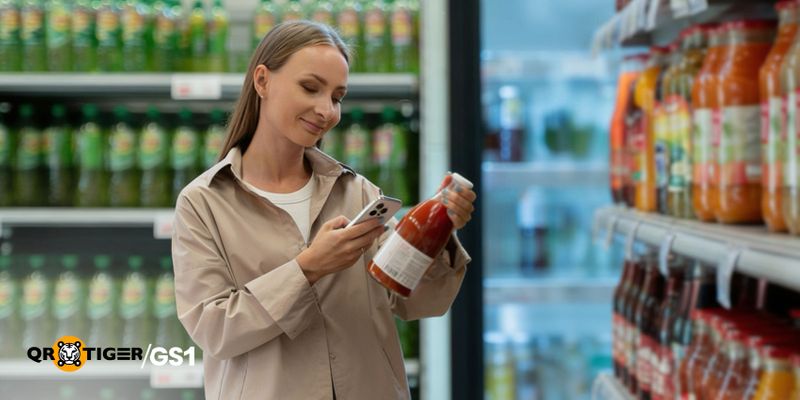
Scanning GS1 QR Codes in retail packaging can give shoppers instant access to nutrition info, allergen details, recipes, how-to videos, sustainability credentials, loyalty rewards, and multilingual content all from a single package. This turns passive packaging into an interactive experience that can drive repeat engagement and brand loyalty.
Traceability & Transparency
Embedded batch numbers, expiry dates, and serial IDs make recalls faster and more precise isolating specific production runs rather than entire product lines. This also supports anti-counterfeiting and meets growing regulatory demands in food, pharma, and electronics. This level of granularity/detail is particularly relevant in food, pharmaceutical, and electronics sectors.
Supply Chain & Retail Operations
Richer scan data helps logistics teams track not just what a product is, but which batch and when it expires enabling automated first-expired-first-out (FEFO) stock management and reducing waste. It also improves data sharing between manufacturers and retail partners for better forecasting.
Sustainability & Regulatory Compliance
Recycling instructions, carbon data, and compliance documents can move to a digital layer via the QR Code, reducing on-pack clutter. For brands subject to the EU Digital Product Passport (DPP), the GS1 Digital Link offers a ready-made compliance framework.
Space Efficiency
One GS1 QR Code replaces multiple barcodes (EAN-13, UPC-A, ITF-14), freeing up valuable packaging space, especially useful on small-format products.
Real-World Use Cases and Case Studies
Across categories and geographies, brands and retailers are already demonstrating the practical value of QR Codes. The following table summarises key deployments and their outcomes.
Company / Sector | Use Case | Outcome / Result |
Procter & Gamble | Consumer-facing product information hub: ingredients, usage, sustainability, recycling via single scan | Reduced multilingual on-pack text; foundation for DPP compliance |
Walmart (USA) | 2D scanning readiness across all US store POS infrastructure; supplier requirements updated to include complianc | Infrastructure ready ahead of Sunrise 2027 |
Unilever | Accessible product information via GS1 QR codes for consumers including those with visual impairments | Enhanced inclusivity and better consumer engagement across global markets |
PepsiCo | GS1 Digital Link QR codes for product transparency, expiry, sustainability, and consumer experiences | Improved supply chain visibility and richer consumer interactions |
Challenges and How to Overcome Them
The transition is genuinely worthwhile, but it is not without friction. Understanding the real challenges and matching them with concrete solutions is what separates successful implementations from stalled pilots.
Technical Challenges
- POS devices and system upgrades: Many retailers operate legacy scanning hardware or middleware that cannot decode 2D symbols without firmware or software updates.
Fix: Retailers should audit scanner estate now, prioritize firmware updates from hardware partners, and pilot 2D scanning at select store formats before chain-wide rollout.
- Printing consistency: Variable print quality across geographies, contract manufacturers, and substrate types can result in codes that pass lab verification but fail in field conditions.
Fix: Embed ISO 15415 verification into every production run approval process, not just initial artwork sign-off.
- Resolver uptime and latency: A QR Code is only as good as the resolver behind it. If the resolver goes down, consumers get a dead scan.
Fix: Use a dependable resolver with backup servers, global content delivery, and real-time monitoring. That way, if one server has issues, another takes over, scans stay fast no matter where users are located, and problems can be spotted before they affect customers.
Design & Branding Challenges
- Aesthetics vs. functionality: Design changes are limited. You can only adjust colors and patterns minimally. The font of the HRI (human-readable text) cannot be changed. You may customize the area around the code, but the QR code itself and the quiet zone must remain untouched.
- Space constraints on small pack formats: Sachets, tubes, and single-serve items leave minimal surface area.
Fix: For this instance, keep the data minimal, usually GTIN plus required details like batch or expiry. This helps keep the symbol small while still being scannable.
Organizational Challenges
- Cross-team coordination: Implementation spans design, IT, supply chain, marketing, legal, and retail, often with no clear owner.
Fix: Appoint a dedicated program lead, map dependencies early, and include QR Code requirements in every packaging brief.
- Data governance: Dynamic links are only useful if the content behind them is accurate and live. Broken or outdated links erode consumer trust.
Fix: Assign content ownership by product category, automate link-checking, and set clear rules for keeping resolver content up to date.
Cost and Migration
- Switching an entire product portfolio especially for brands with hundreds of SKUs across multiple markets requires significant investment in artwork management, data systems, and printing tools.
Ready to Upgrade? Start Using GS1 QR Codes Today
GS1 QR Codes in retail packaging are the practical answer to three pressures that have been building for years: consumers want transparency, retailers need better data, and regulators are demanding greater product accountability.
For consumers, it means going beyond the label accessing the full story of a product, from origin to disposal. For brands, it's a direct line to the moment of purchase, no algorithms or ad spend required. For retailers, it means smarter operations and a supply chain that's finally as digital at the shelf as it is everywhere else.
Sunrise 2027 is a shared moment the entire industry is rallying around. Brands and retailers that treat it as an opportunity, not just a compliance exercise, will come out the other side with packaging that isn't just well-designed, but genuinely intelligent.

FAQS
Is a GS1 QR Code mandatory for my products?
Not universally, but it's moving that way. Sunrise 2027 sets a target for retailers to be able to scan 2D codes at checkout, but it doesn't legally require brands to print them.
The EU Digital Product Passport requires the kind of data density only 2D codes can carry, and in categories like fresh food and infant formula, retailer trading terms increasingly reference 2D code standards.
Are GS1 QR Codes secure?
GS1 QR codes have the same risks as any QR code. They can be covered, replaced, or printed over with a different code.
The QR code itself is not a security feature. It only carries data. You or your system still needs to check if it’s a real GS1 QR code with valid product data, not random text or numbers.
In short, scan GS1 QR codes with the same care as any QR code.
How do I get started with GS1 QR Codes?
You start with your local GS1 member organization. They operate in over 110 countries.
Membership gives access to:
- GTIN assignment
- Implementation guides
- Training and validation tools
- Certified solution providers for QR setup, packaging, and POS testing
You typically need GS1 GTINs first. These are the base product identifiers. QR codes come after that step.

DISCLAIMER: We acknowledge that GS1, as well as the materials, proprietary items, and all related patents, copyright, trademark, and other intellectual property (collectively, “intellectual property”) relating to its use, are the property of GS1 Global, and that our use of the same shall be in accordance with the conditions provided by GS1 Global.
