GS1 Greece: Standards Driving Digital Supply Chains

Industries across Greece have evolved to keep up with digital trade, EU regulations, and customer demand for transparency. From logistics to healthcare, they need product data that is accurate, easy to share, and works across different systems.
GS1 Greece (GR) plays a key role in this transformation by providing globally recognized standards such as GTINs (Global Trade Item Numbers) and barcodes. These tools help Greek companies improve traceability, reduce errors, and ensure compliance with both local and international requirements.
This blog highlights how GS1 helps Greek businesses adopt global barcode standards, improve product data management, and prepare for the shift to 2D barcodes.
Table of Contents
What is GS1 Greece?
GS1 Association Greece is the official GS1 Member Organization for Greece, and the only body recognized by GS1 Global to allocate GS1 company prefixes associated with the Greek country codes 520 and 521.
As an independent, not-for-profit organization, it provides members with guidance, training, and tools to implement GS1 standards across the Greek market. It supports industry adoption through education, events, and collaboration, helping improve product identification and data consistency.
Contact information:
Address: Alexioupoleos 32, 16452 Argiroupoli, Greece
Contact no: +30 210 9904260
Email: info@gs1greece.org
History
In 1985, Greek trade and industry groups SEV (Hellenic Federation of Enterprises) and ESEE formed a non-profit called HELCAN, the Hellenic Centre for Article Numbering.
At the time, GS1 was known as EAN. HELCAN received the license to manage the GS1 system in Greece and was assigned the country prefix 520. For roughly 25 years, HELCAN was the only source of 520 barcodes in Greece and became a core part of the supply chain.
What went wrong (2011)?
GS1 Global later raised concerns about governance. Local GS1 members are required to be non-profit and user-led. GS1 Global concluded that the Greek organization, then operating as GS1 Hellas S.A., no longer met those rules. After a vote at the GS1 General Assembly, the Greek entity was expelled from the GS1 network.
The split market (2012–present)
After the expulsion, the original HELCAN team rebranded as 520 Barcode Hellas. They argued that their historical role and databases made them the rightful issuer of 520 barcodes. They still issue 520 numbers today, but they operate independently from GS1 Global.
To fill the gap, major Greek retailers and manufacturers formed GS1 Association Greece, a new non-profit recognized by GS1 Global. This organization became the official GS1 member for Greece, with barcodes visible in GS1 systems like GEPIR (Global Electronic Party Information Registry).
Where that leaves businesses?
Greek companies now choose between these two providers. The decision usually depends on where they plan to sell and whether GS1 Global recognition matters for their products.
Introduced initiatives and collaborated campaigns
GS1 GR teams up with industry leaders to improve supply chains and support digital transformation.
GS1 GR and the Hellenic Ministry of National Economy and Finance
GS1 GR and the Ministry of National Economy and Finance work together to fight the illicit tobacco trade. To meet the requirements of EU Regulation 2018/574, which introduced a track‑and‑trace system for tobacco products, the Ministry partnered with GS1 GR to create a special marking system.
Since February 2017, new tax stamps for tobacco products have been issued by the Central Bank of Greece. These stamps use GS1 standards and include a GS1 DataMatrix barcode. The barcode stores key product details (such as product specifications, the name of the designated company officer with telephone number, etc.).
This system helps customs and inspectors verify products quickly, whereas consumers can check authenticity by scanning the barcode with a mobile app. These measures strengthen product security, improve traceability, and reduce illegal trade in Greece.
GS1 GR and the National Organization for Medicines (EOF)
jpg_800.jpeg "GS1 GR and the EOF")
Cooperation with the National Organization for Medicines (EOF) for the marking of the authenticity tape
GS1 GR cooperates with the EOF to ensure the authenticity of medicines sold in Greece. To standardize medicine coding, medicines in the country use GS1 codes together with EOF coding.
It is a 13‑digit GS1 code that contains:
- Prefix 280 (special GS1 code for Greece)
- 9‑digit EOF code assigned by the National Organization for Medicines
- Control digit (C) calculated using the GS1 algorithm
This code is displayed in the EAN‑13 symbol printed on the EOF authenticity strip of each medicine package. The system ensures medicines are uniquely identified, traceable, and protected against counterfeiting.
GS1 Greece services for businesses
GS1’s tools and services help businesses work more efficiently and innovate across sectors.
Members Area
The Members Area is an online portal for GS1 GR members, managed individually by each business. It helps companies easily handle their daily barcode, label, and GS1 system tasks from a single place.
It helps businesses manage and assign product codes reliably, store product-to-code records, and access barcode creation, verification, and labeling tools. It supports product promotion through the GS1 Registry and Verified by GS1.
It allows companies to update their details, track service history, and access helpful guides, videos, and standards. It can be accessed anytime on computers or mobile devices.
Barcode software
The software is available in two versions:
Light version: available online via the Member Area for generating EAN-13, EAN-8, and ITF-14 codes)
Full version: provided based on subscription and installed locally, supporting UPC-A, UPC-E, GS1-128, GS1 DataBar, GS1 DataMatrix, GS1 QR Code, and specialized EAN-13 applications).
Access by Membership Tier:
Basic members receive the Light version for up to 5 barcodes. Advanced members have the same version, but get up to 10 barcodes. Both have training and documentation. Premium members receive the Full version with unlimited barcodes and support.
Barcode Verification
To ensure barcodes scan properly, they must be printed correctly. GS1 Greece offers Verification services for member companies, where you can submit printed barcode samples to check their quality and avoid costly readability problems.
Depending on your subscription, GS1 Greece verifies different numbers of barcode labels: Basic covers up to five, Advanced up to ten, and Premium allows unlimited label checks.
This process is performed with specialized barcode verifiers that check and grade print quality. For each GTIN, you receive a detailed report and an official certificate, which can be shared with partners or used for export documentation. Any printing issues are identified for correction.
The service covers all GS1 barcode types.
GS1-compliant QR code generation
This platform lets businesses enter product details and instantly create a GS1 Digital Link QR code. It serves as a flexible digital identity and also generates a unique web page with a dedicated URL. A single scan gives retailers (where supported) and consumers instant access to all shared product information. It helps buyers make informed decisions.
For businesses that prefer stronger product page customization, QR TIGER offers more flexibility. Its GS1 QR Code Generator allows easy control over page layout, design, and content. The result is a branded, engaging product page that remains GS1 compliant.
Verified by GS1
Verified by GS1 is a global registry where brand owners share key product details to ensure each item has a trusted digital identity. It provides seven core data points to define a product, with the flexibility to add more.
This gives marketplaces, retailers, regulators, and consumers a reliable source for product and company information verification.
The service offers four main search functions:
Verify Product (GTIN): Check if a product matches its identity.
Verify Party/Location (GLN): Confirm if an entity or location is genuine.
Find Company: Look up GS1 member companies and their licenses.
Verify other Keys: Validate GS1 keys (SSCC (Serial Shipping Container Code), GRAI (Global Returnable Asset Identifier), etc.) and ownership details.
HellaSync data pool
HellaSync is GS1’s certified GDSN data pool that helps businesses in Greece and abroad share, update, and synchronize reliable product information in a standardized way. It is connected to the GS1 Global Registry and supports millions of product codes globally.
It makes sure product data follows GS1 standards, checking trading unit details to avoid errors and keep information accurate.
It offers over 300 data fields covering logistics, marketing, and regulatory requirements. It is aligned with the GS1 Global Data Model. It also includes Verified by GS1 elements to ensure trusted product information.
HellaSync is used by companies acting as data suppliers or recipients to share and synchronize product information. It ensures trading partners always have the same updated data.
HellasTrace
HellasTrace is an electronic platform that tracks products across the supply chain by capturing standardized data at key points. It is built on the GS1 EPCIS (Electronic Product Code Information Services) standard and shares this information with stakeholders to provide real-time visibility into each product event.
It records product events with time stamps (such as movements or production steps).
It is designed for organizations and businesses that want to strengthen product traceability. The premium package includes exclusive access, personalized training, dedicated support, and a listing of two products in the system.
GLN Registry
The GLN Registry is GS1’s national database that lets you search by GLN, company name, title, or VAT number to confirm location details and validity. Each GLN is a unique 13‑digit identifier that distinguishes companies, sites, or warehouses to support product traceability in the supply chain.
It securely stores business information for national and global transactions.
GS1 Print
This online tool helps businesses quickly create standardized logistics labels for pallets and shipments. These labels, used across the supply chain, include barcodes and key details like product codes, lot numbers, and expiry dates to ensure goods can be tracked from origin to destination.
At the core is the SSCC, a unique identifier for each logistics unit, which requires a GS1 Company Prefix to generate.
It lets businesses quickly create accurate logistics labels online without extra software, add required product details, and automatically archive them for reuse. Labels can be customized with logos, accessed anytime via browser, and printed on a standard office printer. This ensures compliance with international requirements.
Access to the GS1 Association-Greece member area is required to use this service.
Check Digit Calculator
The check digit is the last number in a barcode that ensures it’s valid. In the check digit calculator, you need to choose the code type (GTIN-8, GTIN-12, GTIN-13, GTIN-14, or SSCC) and enter the code without the final digit. The tool will instantly give you the correct check digit.
Global Model Number (GMN)
The GS1 GMN is a unique identifier that links a product to its model or family. It groups products based on common features defined by industry standards or regulations, making it easier to manage and distinguish related items.
It is used in the European Union to meet regulatory requirements for medical devices. It provides the Basic UDI-DI (the identifier required under the EU’s Medical Device Regulation (MDR) and In Vitro Diagnostic Regulation (IVDR)) to ensure compliance and proper identification of regulated healthcare products.
The GMN generator creates a GMN using three elements: a GS1 Company Prefix, an internal reference number, and a check character pair (two uppercase alpha and numeric characters that help catch typing or encoding mistakes).
ProductLoad
ProductLoad is a free GS1 Greece app that lets members quickly photograph products with their mobile phone, update listings in the Member Area, and automatically update the Verified by GS1 registry.
Applications of 2D barcodes across industries in Greece
The retail point of sale (POS) will be ready to read 2D barcodes by 2027. Unlike the traditional 1D barcodes, these advanced codes can store much more information, making it easier to track products and connect with customers. This change, part of the GS1 Sunrise 2027 plan, is designed to make shopping smoother and smarter across both online and offline stores.
For now, 1D barcodes will still be allowed where regulations permit, but many companies are already updating their packaging to include both 1D and 2D barcodes. This way, today’s systems keep working while businesses prepare for tomorrow’s upgrades.
Getting ready for Sunrise 2027 is straightforward. Companies can easily create GS1‑compliant 2D barcodes by following the GS1 official guidelines, or they can use trusted tools such as QR Tiger’s GS1 QR code generator.
For businesses that may lack time or technical expertise, these external solutions provide a quick and reliable way to adopt next-generation barcodes to make the shift smooth and future-ready.
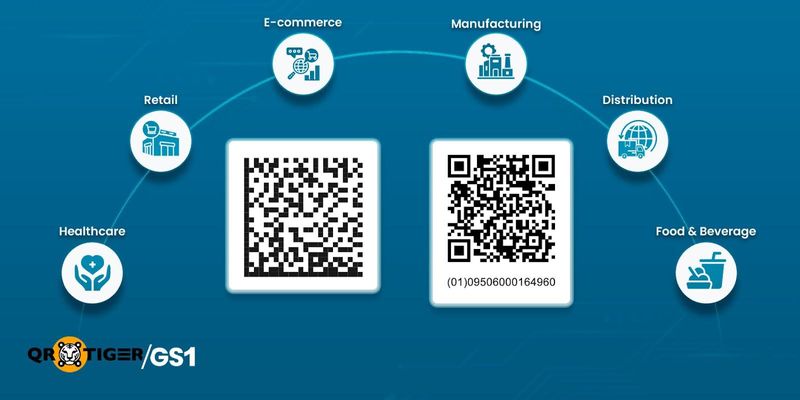
Some of the key applications of these barcodes across industries in Greece are discussed below:
Retail
As part of the Sunrise 2027 initiative, retailers are preparing to make sure all consumer goods packaging stays scannable with 2D barcodes at POS. The ability to store detailed product information reduces errors at checkout and simplifies inventory management.
For example, retailers embed the GS1 Digital Link QR code to connect physical products to digital platforms. This helps them with promotions, traceability features, and promotions that eventually build consumer trust. Consumers can scan these codes to instantly check product details, sustainability certification, nutritional information, and more.
Healthcare and pharmaceuticals
Pharmacies and healthcare providers rely on GS1 DataMatrix to ensure supply chain transparency and patient safety. These codes fit well on small packaging and can encode details such as batch identifiers, serial numbers, and expiry dates. These details make it easy to trace medicines and medical devices from the manufacturer to hospitals.
Healthcare professionals can scan these 2D barcodes to verify authenticity, improve inventory management, reduce counterfeit drugs, and ensure accurate dispensing.
Distribution
GS1’s Scan4Transport standard is used to optimize logistics operations. The sector uses 2D barcodes to encode the SSCC that uniquely distinguishes each pallet, carton, or container. In this way, these codes make sure each unit can be scanned and matched precisely to its transport log.
A logistic partner can scan a GS1 QR code for detailed product information such as handling instructions, shipment ID, and compliance notes. They can get real-time updates on supply chain activity.
Food and agriculture
Consumers increasingly demand transparency in food products, and 2D barcodes help with the same. Food producers use QR codes powered by GS1 Digital Link to ensure product authenticity and safety.
These codes can encode in-depth information about ingredients, batch numbers, harvest date, sourcing, allergens, and more. This makes it easier to trace products from farm to table and thus reassures consumers about safety and sustainability.
Only packaged products carrying GTINs fall under this scope. These codes provide reliable tracking for exported products in the dairy, meat, and horticulture sectors.
Inspiring success stories from GS1 in Greece
GS1 GR supports companies with barcode solutions that improve traceability, safety, and efficiency. These success stories show how GS1 standards create smarter supply chains and strengthen consumer trust in Greece.
FAGE Greece S.A.
FAGE Greece S.A. is a Greek dairy manufacturer that has been producing yogurt and other dairy products for several decades. The manufacturer aims to always maintain the product quality and enhance supply chain processes.
It faces three main challenges: adapting to local rules, building a strong digital presence, and meeting partner demands for online listings and a digitized supply chain. To address these challenges, it partnered with GS1 GR.
In 2014, FAGE was one of the first companies to use the GS1 Global Data Synchronisation Network via HellaSync.
HellaSync, a certified GS1 GDSN data pool, connects users to the GS1 Global Registry. It lets partners in Greece and abroad easily enter, store, exchange, and synchronize complete, reliable product data in a standardized way.
FAGE formed an internal team with HellaSync to train staff and align ERP (Enterprise Resource Planning) product data with GS1 GDSN standards. Today, over 90% of its 350 products, each with about 100 attributes, are listed and shared with partners in Greece and across more than a dozen countries.
Results: Using GS1 GDSN as a single source of product data has increased the manufacturer’s operational efficiency. They now share product information in only 20% of the time it used to take. The centralized data repository ensures smoother processes across all departments.
FAGE continues to update digital product listings to meet customer needs and grow sales. It plans to integrate HellaSync into its ERP systems.
Athens General Military Hospital
Speed and accuracy are vital in army supply chains. Since 1904, 401 Athens General Military Hospital, the largest in Greece, has aimed to deliver the same efficiency to its patients.
The hospital struggled with inventory management due to the lack of standardized coding and naming. This made it hard to track operating room stock, monitor devices used in surgeries, and maintain accurate shelf levels.
Manual recording often led to errors, while the ERP system failed to ensure proper traceability of high‑risk items like implants. Adding devices to patient records was also slow and error‑prone.
To address these challenges, there is a need for unique identification and automated data capture of invasive, high‑risk, and high‑cost medical materials. This applies especially to devices used in the operating room, catheterization lab, and interventional radiology department.
In 2017, the hospital piloted GTINs and GS1 barcode scanning in some operating rooms (OR). By 2018, it expanded them to the catheterization lab and interventional radiology for tracking inventory and registering medical devices in patient records.
Results:
Better patient safety: Expiration dates are automatically checked before medical devices are used in surgeries.
Improved stock management: Departments can easily manage inventory and track consignment items.
Faster stock counting: The Catheterization Lab reduced stock counting time by over 85% compared to manual work.
Wider adoption: The nurse engagement made it possible to expand the use of GS1 to other departments and thus improved the workflows.
Strong ROI: €10,000 hardware spend was recovered in a year, yielding €21,000 net gain in 2018 from replacing short‑expiry items.
The Greek Army Medical Supplies Centre
The Greek Army Medical Supplies Centre deals with buying, storing, and distributing medicines and medical devices to regional warehouses and hospitals, serving army personnel and their families.
The Centre records all product data in its ERP system, but the process is manual and prone to errors. It leads to problems like wrong orders, delayed fulfillment, slow recall responses, and expired stock. It used GS1 standards to significantly reduce errors and automate its warehouse operations.
Products are uniquely identified using GS1 GTINs with batch, lot, and expiry details encoded in GS1 DataMatrix and GS1‑128 barcodes. For its own pharmaceuticals, the Centre applies GS1 GTINs on all packaging levels, and for items arriving without barcodes, it assigns GTINs and prints barcode labels itself.
Each warehouse shelf carries a unique ID, and products are scanned when arrived and placed on shelves to record their exact location in the WMS (warehouse management system). Any stock movement is tracked by scanning old and new shelf barcodes. This makes receipt faster and ensures accurate invoicing and quicker order fulfillment.
Scanning a carton once instead of scanning for each item saves time, reduces errors, and helps manage outdated stock.
Results:
Stock accuracy for fast‑moving items increased to 96% (a 10% boost).
Order error rate fell from 10% to 3%.
Fulfillment time reduced by 25–30%.
Productivity improved as order fulfillment became faster and there were fewer reworks.
Recall response became faster due to lot/batch traceability in warehouses.
 Driving Digital Transformation in Greece’s Economy
GS1 Greece helps companies build smarter and more transparent supply chains by offering global standards for product identification, data sharing, and tracking. Its services make it easier for businesses to comply with EU regulations, improve traceability, and optimize operations across industries.
By joining GS1, Greek businesses gain access to trusted tools and expert support that reduce errors, boost efficiency, and enhance customer trust. As Greece’s economy adopts digital transformation, GS1 helps build supply chains that are efficient, future‑ready, and connected worldwide.
FAQs
1. What prefixes does GS1 GR issue for barcodes?
GS1 Association Greece is the only official global member in Greece, issuing the 520 and 521 prefixes. These codes link products to a Greek brand owner in the global GS1 database, regardless of where the product is manufactured.
Important Distinction: You will also encounter 520 Barcode Hellas (formerly HELCAN). While they issue codes starting with 520, they are an independent organization no longer affiliated with the global GS1 network.
- GS1 Association Greece: Required for international trade and major platforms like Amazon.
- 520 Barcode Hellas: Primarily suitable for the local Greek market and smaller independent retailers that do not require global database verification.
2. What tool has replaced GEPIR for barcode verification?
As of late 2023, Verified by GS1 has replaced GEPIR. This tool provides reliable, verifiable product, company, and location information for GS1 codes, ensuring transparency and reliability in global trade.
3. How does GS1 GR help with exports and international trade?
GS1 GR helps Greek companies sell products abroad by giving them GS1 identifiers and corresponding barcodes that are accepted worldwide. These make it easier to identify products, share data, and manage trade. This makes exports faster and more efficient.