
GS1 Israel: Global Standards for a Connected Economy

GS1 In Israel, industries from retail and healthcare to agriculture and logistics embrace trusted standards and digital transformation to stay competitive in a connected global economy. Accurate product identification, seamless data sharing, and reliable tracking are essential for businesses to meet regulations, improve efficiency, and expand into international markets.
GS1 Israel (IL) supports this shift by providing globally recognized standards such as GTINs (Global Trade Item Numbers) and barcodes. With these tools, companies can optimize their operations, improve traceability, effectively connect to global supply chains, and better serve customers.
This blog explores how GS1 enables businesses to adopt global barcode standards, enhance supply chain transparency, and prepare for the shift towards 2D barcodes.
Table of Contents
What is GS1 Israel?
Founded in Jan 18, 1983, GS1 IL, then known as the Association for Product Coding in Israel (MAMI). Israel was the 17th country to join the GS1 organization and the second country outside Europe and the United States to do so. It is the official representative of the global standard organization GS1. It is the sole authority licensed to issue GS1 barcodes and GTINs in Israel.
The member organization (MO) provides support and guidance for implementing GS1 standards across the country. It provides infrastructure for information exchange between trading partners and provides solutions that complement business operations.
GS1 IL contributes to a greener future by sharing information that drives better environmental practices. It works with industry partners to enhance product performance and ensure reliable tracking.
Contact information:
Address: 26 Harokmim St., 5885849 Holon, Israel
Contact no: + 972 3 519 87 14
Email: info@gs1il.org
Introduced initiatives and collaborated campaigns
GS1 IL works with industry leaders to promote global standards that support digital innovation and efficient supply chain systems.
Israel's Industry 4.0
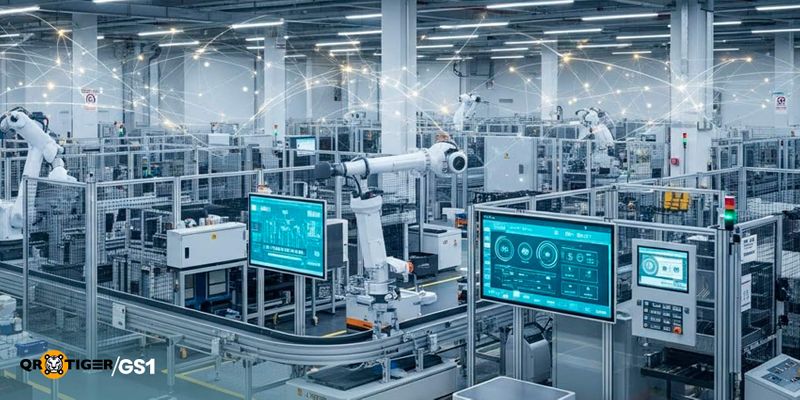
Established in 2018 by Start-Up Nation Central, the II4 (Israel Industry 4.0 Community) builds global networks and partnerships in industrial and manufacturing sectors to speed up the use of Industry 4.0 technologies.
The community empowers members to deliver solutions and services that address supply chain and manufacturing issues locally and globally. GS1 plays a role here since its standards guide many of these companies.
It entails technologies that digitize the whole production process by connecting machines and equipment to data systems for tracking and insights.
It connects innovators, manufacturers, investors, and global partners to form a community that drives collaboration to strengthen the industry.
Information Security Directive
The Directive was created during COVID-19 for testing products, but applies to all IVD (In Vitro Diagnostic) products.
It helps organizations and individuals follow updated Public Health Regulations for diagnostic product coding. It ensures reliable results in remote tests by requiring healthcare providers to use the Unified Diagnostic Product Identifier (UDPI).
Every test kit, whether from manufacturers, distributors, or dispensers, must be verified with this identifier to support product tracing across the pharmaceutical supply chain. The UDPI structure must follow the latest GS1 General Specifications.
The UDPI must be represented in a GS1 DataMatrix format. This 2D barcode should be placed directly on the same surface as the diagnostic element. It can be printed, engraved, or affixed.
The Human Readable Interpretation (HRI) must show the text linked to each Application Identifier (AI) and be placed on every product package next to the GS1 DataMatrix barcode.
GS1 IL services for businesses
GS1 empowers businesses with tools and services that support innovation and help boost productivity.
Digital Item Catalog
The Digital Item Catalog is an online platform where brand owners manage, and share verified product information with retailers, suppliers, distributors, and other trading partners. It serves as a single trusted source that ensures reliable and consistent product data across the supply chain.
The database stores details such as products’ GTINs photos (including 3D views), kosher nutritional values, and more.
The catalog helps brand owners update product information in one central place instead of separately with each trading partner. It also helps enhance sales with rich visual content.
Verified by GS1
Verified by GS1 is a free online lookup tool that allows anyone to check if a GTIN (barcode number) is registered in the GS1 global database.
Simply enter a GTIN, and the tool will show:
- Whether the GTIN exists in the GS1 system
- Which GS1 Member Organization (MO) issued it
- Which company owns/licensed that GTIN
This helps verify that a barcode is legitimate and identify who is authorized to use it. It's a quick way to confirm GTIN authenticity and ownership.
Check Digit Calculator
GS1 provides a check digit (fin for every generated GTIN. Once the GS1 prefix and item reference number are combined, the check digit is calculated and added to complete the code.
The check digit serves as a safeguard against errors. When a barcode is scanned, systems use it to verify the GTIN was entered or printed correctly. If any number is mistyped or misread, the check digit validation fails, preventing mistakes from affecting the supply chain.
Global Model Number (GMN)
The GS1 Global Model Number (GMN) is a unique identifier that links a product to its model or family. It groups products based on common features defined by industry standards or regulations, making it easier to manage and distinguish related items.
The GS1 GMN is used in the European Union to meet regulatory requirements for medical devices. It provides the Basic UDI-DI (the identifier required under the EU’s Medical Device Regulation (MDR) and In Vitro Diagnostic Regulation (IVDR)) to ensure compliance and proper identification of regulated healthcare products.
The GMN generator creates a GMN using three elements: a GS1 Company Prefix, an internal reference number, and a check character pair (two uppercase alpha and numeric characters that help catch typing or encoding mistakes).
Applications of 2D barcodes across industries in Israel
Retail POS will be able to scan 2D barcodes by 2027. Unlike the 1D barcodes, these advanced codes hold far more details, making it easier to track items and build stronger connections with customers.
This change is driven by the GS1 Sunrise 2027 initiative that is designed to simplify and improve shopping, online and in-store.
The rollout depends on the industry; it is not mandatory for all sectors. Industries outside traceability regulations, including those not part of the EU Digital Product Passport (DPP) regulation, can continue using 1D barcodes if they prefer.
Many businesses are adopting dual marking (printing both 1D and 2D barcodes on packaging) to keep existing systems running smoothly and prepare for future upgrades.
To stay prepared for Sunrise 2027, brands can create GS1‑compliant 2D barcodes on their own by following GS1 official guidelines or use trusted third‑party platforms such as QR Tiger’s GS1 QR code generator.
For companies short on time or technical know-how, external solutions offer a fast and reliable way to adopt next‑generation barcodes. This approach makes the shift smooth, practical, and ready for the future.
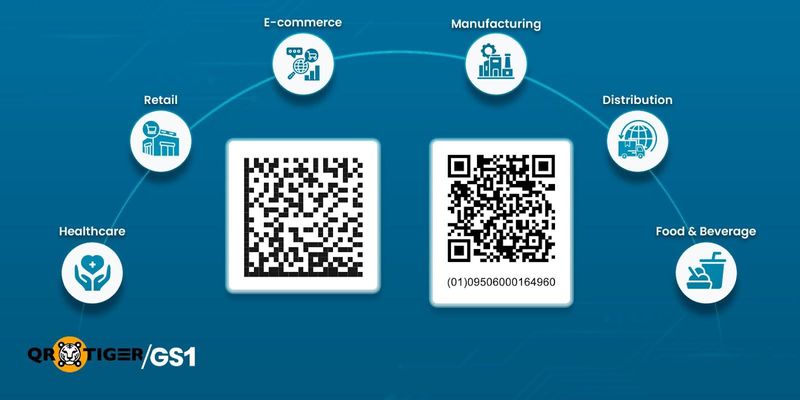
Healthcare
GS1 DataMatrix barcodes are increasingly used on medical devices and pharmaceuticals. They help meet global regulatory requirements and improve patient safety. With these 2D barcodes, hospitals and pharmacies can encode data such as serial numbers, and expiration dates to ensure accurate tracking.
These barcodes reduce the risk of counterfeit medicines and optimize inventory management.
Retail
The sector uses GS1-compliant 2D barcodes to connect physical products to online experiences. They improve the point of sale (POS) operations and consumer engagement.
Unlike 2D barcodes, these 2D barcodes (such as GS1 DataMatrix and GS1 QR codes) can store detailed product information (such as ingredients, batch numbers, expiration dates, links to digital content, etc.).
Suppose consumers scan a GS1 Digital Link QR code, they can access web-based verified product information. With these codes, retailers can build brand trust and stay competitive globally.
Food and agriculture
Food producers and supermarkets use 2D barcodes to track products, making it easy to spot and remove affected items during recalls. This protects consumers and helps reduce financial losses.
For example, consumers can scan a GS1 QR code to access verified data on nutritional values, allergens, and kosher certification. This unified flow of information helps Israeli retailers and suppliers meet both local regulations and international export requirements, ensuring food safety and quality across the supply chain.
Distribution
In logistics, 2D barcodes are used to make transport and warehouse operations more efficient. GS1’s Scan4Transport standard is used to simplify logistic operations. It encodes the Serial Shipping Container Code (SSCC) to uniquely identify each carton, container, and pallet.
Logistic partners can easily scan each logistics unit that is printed (on a transport label) with a 2D barcode carrying SSCC. For example, when they scan a QR code powered by GS1 Digital Link, they can access details such as handling instructions, destination information, and regulatory information. This speeds up receiving goods and makes the supply chain more transparent.
 Strengthening Israeli Supply Chains with Global Standards
GS1 Israel helps businesses grow by offering global standards that make product tracking, data sharing, and identification easy and reliable. Its services help companies, from retail to logistics, streamline operations, meet regulatory requirements, and stay transparent with partners and consumers.
By joining GS1, businesses gain access to trusted tools and expert guidance that reduce errors, cut costs, and build confidence in the marketplace. As Israel continues its shift toward digital growth, GS1 provides the base for smarter supply chains that help companies stay competitive both locally and globally.
FAQs
1. Why should businesses in Israel use GS1 standards?
Businesses in Israel should use GS1 standards because they provide a universal way to identify products, locations, and packages across the global supply chain, ensuring smooth operations.
By using GS1 barcodes, companies can share accurate, high‑quality product information with trading partners and stakeholders. This access to reliable data reduces errors, cuts unnecessary costs and waste, and builds trust through transparency.
2. How does the GS1 Digital Item Catalog empower businesses in Israel?
GS1 Digital Item Catalog is a central hub for reliable product information. It allows retailers, distributors, suppliers, and partners to access everything they need in one place: product barcodes, immersive product visuals, nutritional values, kashrut certifications, and logistical details.
This uniform platform makes launching new products, managing online sales, and sharing data with stakeholders simple and efficient. It helps reduce errors and cuts unnecessary expenses to make online trade cost-effective.
3. What is a supplier number, and why does it matter for Israeli businesses?
A supplier number gives you the right to create barcodes that identify products, packages, and locations. Each comes with a capacity; some allow you to code a few hundred items, while others can handle thousands.
The number links barcode rights to your company to make sure each code you create is unique globally and easy to track. Choose a vendor number that fits your current product range and supports future business needs.

DISCLAIMER: We acknowledge that GS1, as well as the materials, proprietary items, and all related patents, copyright, trademark, and other intellectual property (collectively, “intellectual property”) relating to its use, are the property of GS1 Global, and that our use of the same shall be in accordance with the conditions provided by GS1 Global.
