
GS1 Chile: Enabling Smarter, More Transparent Value Chains

A silent language connects Chilean goods to the rest of the world in the busy ports of Valparaíso, the huge vineyards of the Maipo Valley, and the salmon farms of Patagonia.
GS1 Chile is the group that makes it possible for that language to be spoken in Chile. They do this through barcodes, traceability systems, and global data standards.
Most people know the black-and-white barcode that is on most things they buy, but few know that it is one of the most important forces in modern business that they can't see.
Table of Contents
What is GS1 Chile?
GS1 Chile(CL) is the official representative of GS1 in Chile. GS1 is a global non-profit organization that more than 2 million companies in 150+ countries trust.
It is the only official body that can give out official GS1 codes. This makes it possible for businesses operating in Chile, from small berry exporters to large pharmaceutical distributors, to speak the same universal language as Walmart, Amazon, and major hospitals around the world.
Contact Information:
Address : Vitacura 2771 - Piso 7 Las Condes Santiago de Chile
Contact No. : + 56 2 3278 3503
Email: info@gs1chile.org
Introduced Initiatives and Collaborated Campaigns
GS1 Chile has been instrumental in promoting the adoption of global standards and supporting businesses in their transition to modern barcode technologies.
CENABAST & Healthcare Traceability: Strengthening the Public Health Supply Chain
CENABAST (Central Nacional de Abastecimiento), the National Supply Center for Chile’s public health system under the Ministry of Health, plays a critical role in procuring and distributing drugs, medical supplies, and consumables to hospitals and health services nationwide.
To address challenges in stock management, product identification, and patient safety, CENABAST adopted GS1 standards as the common “language” for its entire supply chain. This included requiring suppliers to use GS1 identifiers (such as GTINs) and 2D barcodes on products for accurate tracking of batches, expiration dates, and serial numbers.
The initiative was part of a broader effort by the Western Metropolitan Health Service (SSMOCC) and the National Health System to implement a world-class Hospital Information System (HIS) with Electronic Health Records.
By aligning with CENABAST’s GS1-based system, hospitals gained precise visibility into medicinal products and supplies, reducing errors, enabling faster recalls, and improving overall logistics efficiency.
Congreso GS1 Trazabilidad (Traceability Congress)
One of its flagship events, the Congreso GS1 Trazabilidad has become a leading annual gathering for supply chain professionals.
Held for over a decade, the congress brings together industry leaders, experts, and companies to discuss the latest trends in traceability, sustainability, food safety, and digital innovation.
The 2025 edition, hosted at the Hotel Sheraton in Santiago, attracted over 250 in-person attendees and hundreds more via streaming.
The event included Expo Traza, which showcased technology solutions, real success stories, and practical ways to improve operations. It highlighted how traceability helps businesses become more efficient, secure, and competitive in Chile’s value chains.
GS1 Day & Premios GS1
GS1 Day is an annual celebration that marks the achievements of the GS1 system in Chile. During this event, it recognizes outstanding companies through the Premios GS1 (GS1 Awards).
Categories typically include Trajectory, Innovation, Entrepreneurship, and Special Recognition. Recent winners have included companies like Cocalán Alimentos, SMU (supermarkets), and Miguel Maritano Industria de Jabones.
The awards highlight organizations that demonstrate excellence in implementing GS1 standards and driving industry progress.
SERCOTEC Centers
GS1 has established important collaborations with SERCOTEC (Servicio de Cooperación Técnica) to support micro and small businesses.
A notable example is the agreement signed with the SERCOTEC Business Center in Puerto Varas (2026), aimed at improving competitiveness through training on GS1 standards, barcodes, and traceability.
These partnerships help small producers and entrepreneurs gain access to global markets by adopting internationally recognized identification and data-sharing practices.
Law No. 19,886 on the Bases of Administrative Contracts for Supply and Service Provision
GS1 CL supports the Chilean public procurement ecosystem by providing standardized product identification and maintaining the CATE electronic catalog. Product data registered in CATE is used to support consistent product information across procurement processes within ChileCompra systems.
Under Chile’s public procurement framework, the Convenio Marco catalog is commonly the primary purchasing mechanism considered by public entities before other procurement processes. For this reason, accurate product identification is important to ensure products can be correctly matched within procurement platforms.
CATE is the organization’s electronic catalog system that allows suppliers to manage product registration, including barcode (Global Trade Item Numbers or GTIN) assignment and updates to product attributes, supporting standardized data exchange across the supply chain.

GS1 Chile services for businesses
GS1 has a full range of services that can help businesses of all sizes, from small producers to big corporations, use global standards effectively.
These services are all about making things more productive, lowering costs, making things easier to trace, and opening up new markets.
Assignment of GS1 Codes
At the core of its offerings is the Assignment of GS1 Codes.
As the only official organization authorized to do so in Chile, GS1 issues GS1 Company Prefixes (starting with 780), GTINs for products at different packaging levels, GLNs for locations, and SSCC codes for logistics units.
These codes serve as the essential foundation for barcodes, traceability, and international trade.
Support
They offer consulting, audit, and training services that help companies apply global standards in logistics, systems, and traceability. Each service focuses on a specific operational area, from labeling and equipment selection to full traceability implementation.
- Logistics Label Consulting: Supports the design of logistics labels aligned with international standards, ensuring proper readability across the supply chain.
- Hardware Consulting for Automatic Reading: Guides companies in selecting barcode scanners, printers, and related equipment, including supplier and market references.
- Software Consulting: Identifies gaps in logistics systems (such as WMS and inventory tools) and supports updates to align with GS1 standards.
- Identification Consulting: Provides recommendations on data capture tools, logistics software functions, and steps for implementing GS1 standards.
- Traceability Consulting: Supports the development of end-to-end traceability systems covering raw materials, production, and finished goods.
- Traceability Audit: Evaluates traceability systems for efficiency and compliance using GS1 and international standards such as ISO, HACCP, and BRC.
- Traceability Management System: A complete program that combines all consulting services and ends with a full traceability audit for companies implementing GS1 standards from the ground up.
- Training Programs: Provides courses and workshops that help professionals understand and apply GS1 standards in areas such as supply chain management, identification systems, and traceability practices.
Data Quality Verification
This service checks what your data says about the product.
They review actual product samples in your warehouse or distribution center. Then they compare what’s printed on those products, like GTINs and labels, against what is stored in the GS1 Chile Electronic Catalog (CATE).
Think of it as a data audit.
It answers questions like:
- Is this product correctly registered in GS1?
- Is the GTIN being used properly?
- Does the product hierarchy make sense? Example: unit, case, pallet
- Does the physical product match the database entry?
What you get from it
- A percentage of products correctly registered
- Identification of incorrect or duplicated codes
- Detection of mismatched product structures
- Cleaner, synchronized product data across systems
In simple terms. Your database and your physical products should agree. This service checks if they actually do.
Barcode Verification
This service checks whether your barcode can be scanned reliably.
The organization uses specialized verification equipment to test the printed barcode. It evaluates if scanners across the supply chain can read it بسهولة, from retail checkouts to warehouse systems.
This follows GS1 standards and ISO 15416, which is the global grading system for barcode quality.
Think of it as a print and scan test.
It answers questions like:
- Is the barcode clear enough to scan every time?
- Is the print quality within acceptable standards?
- Will it work across different scanners and environments?
What you get from it
- A quality grade for each barcode
- Identification of printing issues (contrast, size, damage)
- Assurance that scanners can read it consistently
In simple terms. Even if your data is correct, a poorly printed barcode will still fail. This service checks the physical scanability.
Right now, the service description does not clearly say if it supports 2D barcodes, like QR codes or GS1 DataMatrix. Since 2D barcodes are checked using a different standard (ISO 15415), companies that need this should confirm with GS1 Chile if it is included or offered as a separate service.
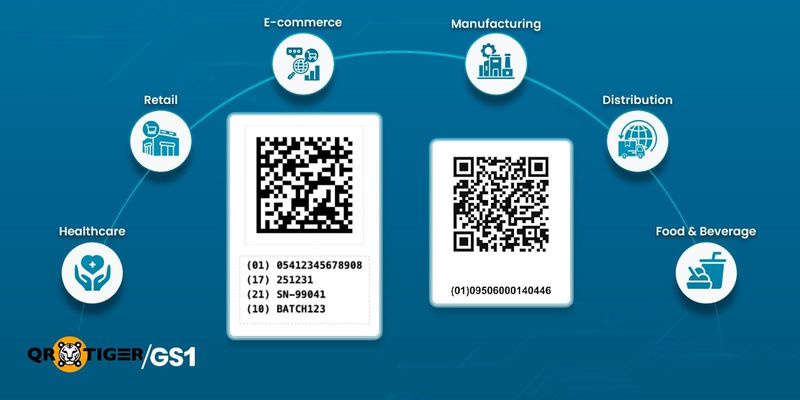
Application of 2D Barcodes Across Industries in Chile
GS1 Two-dimensional (2D) barcodes, including QR codes and GS1 DataMatrix, have become essential tools in Chile's economy.
They store significantly more data than traditional 1D barcodes, enabling enhanced traceability, consumer engagement, regulatory compliance, and operational efficiency.
GS1 promotes its adoption through standards like GS1 Digital Link, which connects physical products to rich digital information.
Healthcare
In Chile's healthcare sector, 2D barcodes improve patient safety, medication management, and supply chain visibility for pharmaceuticals and medical devices.
GS1 DataMatrix codes are mandatory because they encode critical details such as batch/lot numbers, expiration dates, serial numbers, and Global Trade Item Numbers (GTINs) in a compact, high-density format.
Hospitals and clinics use them on product packaging, patient wristbands, and medication labels to reduce errors in dispensing and administration.
Food & Beverage / Fresh Produce / Agriculture
The country’s agri-food sector, known for exporting fruits such as table grapes, berries, and cherries, as well as salmon and wine, relies heavily on effective traceability systems to manage complex supply chains.
The use of GS1-compliant 2D barcodes on product packaging enables users across the supply chain to capture and access key traceability data, including lot numbers, harvest dates, origin, production methods, and certifications.
These stakeholders include farmers, processors, exporters, distributors, retailers, and regulators, all of whom rely on standardized data to improve visibility from farm to export and support product quality and compliance with international requirements.
In the food and beverage sector, 2D barcodes can also help improve inventory control and reduce waste by enabling more accurate tracking of expiry dates and product movement. This allows businesses to respond more quickly to quality issues, manage recalls more efficiently, and optimize stock rotation.
As global demand for transparency and stricter export regulations continues to grow, 2D barcodes are helping Chilean producers strengthen traceability, improve food safety, and remain competitive in international markets.
Retail & Consumer Goods
In Chile, the retail and consumer goods sector is increasingly adopting 2D barcodes to improve operational efficiency across both front-end and back-office systems.
While traditional 1D barcodes continue to support basic point-of-sale (POS) functions, GS1-compliant 2D barcodes enable retailers to capture more detailed product data in a single scan.
This includes information such as batch numbers, expiry dates, and product identifiers, which can enhance inventory management, stock rotation, and traceability.
For retailers, this means better control over product movement, improved accuracy in pricing and checkout processes, and more efficient handling of recalls and quality issues. It also supports stronger data consistency across in-store and online systems, helping improve omnichannel operations.
Logistics
GS1-compliant 2D barcodes enable logistics providers to capture and share detailed data, including product identifiers (GTIN), shipment identifiers (SSCC), and location data (GLN). This supports more accurate tracking of goods as they move through warehouses, distribution centers, and transport networks.
In sectors like fresh produce and cold chain logistics, 2D barcodes can and are used alongside monitoring systems to maintain visibility over product conditions and movement. This helps ensure product integrity, supports faster issue resolution, and improves coordination among supply chain partners.
Overall, the use of these barcodes in logistics can enhance inventory control, strengthen traceability, and enable more efficient and reliable operations across Chile’s export-driven supply chains.
Inspiring success stories
GS1 CL has played an important role in helping businesses adopt global standards for product identification, traceability, and data sharing across different industries.
Through its Traceability Conformance Program and partnerships with both public and private organizations, it has helped companies improve efficiency, safety, and transparency.
Here are three examples that show how these standards are making a difference in Chile.
Icestar: The First Company in Chile to Achieve GS1 Global Traceability Conformance
Icestar, a leading refrigerated warehousing and logistics company in Chile, made history in November 2007 as the first company in the country to receive a successful Chile Traceability Conformance Report.
GS1 CL performed an extensive review by applying the GS1 Global Traceability Conformance Programme approach.
As a result, their processes and systems were improved to collect and share data more efficiently.
The successful audit showed that Icestar can provide full traceability, allowing faster product recalls, better stock management, and compliance with export requirements, especially for fruits and seafood.
Hospital Naval Almirante Nef: Pioneering GS1 Adoption in Chilean Healthcare Facilities
In June 2024, Hospital Naval Almirante Nef (a major naval hospital in Viña del Mar) announced it would become the first healthcare center in Chile to fully adopt GS1 standards across its operations.
This forward-thinking initiative aims to implement GS1 identification and traceability throughout the hospital’s supply chain, from receiving medical devices and pharmaceuticals to point-of-care usage.
The project positions Hospital Naval Almirante Nef as a national pioneer, paving the way for other public and private hospitals to modernize their systems.
Final Thoughts
Ultimately, GS1 Chile is helping businesses build more connected and reliable supply chains today. Through standardized identification, data sharing, and traceability, companies are improving visibility, reducing errors, and responding faster to market demands.
At the same time, these foundations prepare organizations for what comes next. Technologies like IoT(Internet of Things), blockchain, and real-time analytics rely on clean, consistent data to work effectively.
GS1 standards make that possible. Without that structure, even the most advanced tools fall short.
Businesses that adopt these standards are in a stronger position to support transparency, improve operations, and create long-term value.
This benefits not just individual companies, but the wider network of producers, retailers, and consumers across Chile.
The shift toward more intelligent and connected value chains is already underway. And GS1 Chile continues to play a steady, practical role in helping enterprises move forward with clarity and confidence.

FAQS
What is the difference between EAN and GTIN?
Global Trade Item Number (GTIN) is the general name for product numbers used worldwide. These numbers can be any length, like 8, 12, 13, or 14 digits.
European Article Number (EAN) is one specific type of GTIN. It usually refers to the 13-digit barcode you often see on retail products outside North America.
How do I get a barcode for my product in Chile?
To obtain a legitimate, globally recognized barcode in Chile, you need a GS1 Company Prefix licensed and issued by GS1 CL. This prefix allows you to create unique GTINs (barcodes) for your products.
Steps to get your barcode:
- Visit the GS1 website and submit a request for a GS1 Company Prefix.
- Provide basic company information and details about the number of products you need to identify.
- Once approved and after becoming a member, GS1 assigns your unique Company Prefix.
- Using your prefix, you can then generate individual GTINs for each product variant.
- Generate your 1D or 2D barcode using GS1-approved tools or design software.
How is a GS1 2D barcode different from a regular QR Code?
A standard QR Code can store any text or link without a set format. A GS1 QR Code follows GS1 rules, so systems can read product data like GTIN, expiry date, and batch.
This makes it usable at POS, while standard QR Codes are not.

DISCLAIMER: We acknowledge that GS1, as well as the materials, proprietary items, and all related patents, copyright, trademark, and other intellectual property (collectively, “intellectual property”) relating to its use, are the property of GS1 Global, and that our use of the same shall be in accordance with the conditions provided by GS1 Global.
