
What Is Smart Packaging? Types, Examples, and Benefits

TL;DR
|
Smart packaging combines packaging materials and technologies with functions that support a product throughout its life.
It is a complete system where every part—the container, label, cap, insert, or sensor—works together. A smart package includes all of these parts and features, not just the outer box or bottle.
It can:
- Change or improve the environment inside the package
- Check and report the product's condition
- Share helpful details about the product
- Connect the physical package to digital information
There are three main types:
Active Packaging
Active packaging does something to the product or its surrounding environment.
It can absorb, release, block, or control something inside the package. The goal is usually to help maintain freshness, quality, safety, or shelf life.
Active packaging can take different forms. The same function may appear as a sachet, pad, film, coating, sticker, or part of the package itself.
1. Oxygen and Carbon Dioxide Control
Different gases can affect product quality in different ways. Active packaging can control oxygen (O₂) and carbon dioxide (CO₂) levels inside a package to help maintain product quality and shelf life.
Oxygen control: Oxygen can cause oxidation, which can lead to changes in flavor, color, and freshness. It can also support the growth of some microorganisms. Active packaging can use oxygen absorbers or oxygen-scavenging materials to reduce oxygen inside the package.
Commercial Examples: Avient's Amosorb and Sealed Air's Cryovac oxygen-scavenging films.
CO₂ control: Carbon dioxide can affect the quality and shelf life of products such as fresh meat, fish, coffee, baked goods, and fresh produce. Depending on the product, too much or too little CO₂ can affect freshness, texture, or other quality characteristics. Active packaging can use CO₂ absorbers or emitters to maintain a suitable level.
Commercial Example: CO2 Technologies' CO2 Fresh-Pads.
Did you know? Sealing a package does not always mean that no gases can enter. Plastic and other packaging materials can allow gases to pass through them slowly. This process is called permeation. Over time, gases from the outside environment can permeate through the packaging material and enter the container. These gases, like oxygen, may also remain inside the package after sealing |
2. Moisture Control
Too much moisture can make food soggy, cause clumping, encourage mold growth, or damage moisture-sensitive products.
Active packaging can remove or control moisture inside the package.
Examples include:
- Desiccant sachets
- Moisture-absorbing pads
- Moisture-absorbing films
- Moisture-control materials
Clariant's Desi Pak and Sorb-It are commercial examples of desiccant products used to protect moisture-sensitive goods.
Newer packaging can also build moisture absorption into the package itself. ProAmpac and Ozzi, for example, developed a moisture-absorbing film for Ozzi's Crave Crusher drink mix.
Here, the package actively removes moisture instead of simply preventing water from entering.
3. Ethylene and Ripening Control
Many fresh fruits and vegetables produce or are sensitive to ethylene, a gas that speeds up ripening and aging.
Active packaging can remove ethylene or reduce its effect. This can help slow ripening and extend the usable life of fresh produce.
Examples include:
- Ethylene absorbers
- Active stickers
- Packaging that releases a ripening inhibitor
Fresh Inset's Vidre+ is a commercial example. Its active sticker releases 1-MCP, which blocks the effect of ethylene on produce.
Fresh Inset also developed MCPBag, which incorporates the technology directly into a produce bag.
The packaging is therefore doing more than holding the produce. It actively helps control the ripening process.
4. Microbial Control
Some active packaging helps slow the growth of bacteria, mold, and other microorganisms.
Antimicrobial substances can be added to:
- Films
- Coatings
- Pads
- Other packaging materials
Some systems release an antimicrobial substance gradually. Others use materials that already have antimicrobial properties.
Aptar Food Protection's InvisiShield is a commercial example of an active packaging technology developed to help protect food from bacteria, viruses, and fungi.
Other active packaging research and commercial development uses materials such as chitosan and plant-based compounds for antimicrobial protection.
5. Temperature Control and Heating
Some active packaging helps control the temperature around a product, either by buffering temperature changes or by adding heat.
Thermal Buffering: Phase-Change Materials (PCMs) absorb or release heat as they change state, helping hold a product within a set temperature range. They are used in food transport and other temperature-sensitive products.
Commercial example: Thermal Packaging Solutions and other suppliers offer PCM-based systems designed to maintain specific temperature ranges during transport.
Microwave Susceptors: Special materials in the package absorb microwave energy and convert it into heat. This helps brown and crisp foods during microwave heating.
Commercial example: Graphic Packaging International's Qwik Crisp.
Self-Heating Packaging: Built-in heating components produce heat without a microwave, stove, or electrical power.
Commercial example: Luxfer Magtech's Flameless Ration Heater, which uses a magnesium alloy that reacts with water to produce heat for meals.
All three are active because the packaging does more than contain the product. It actively controls or adds heat.
Intelligent Packaging
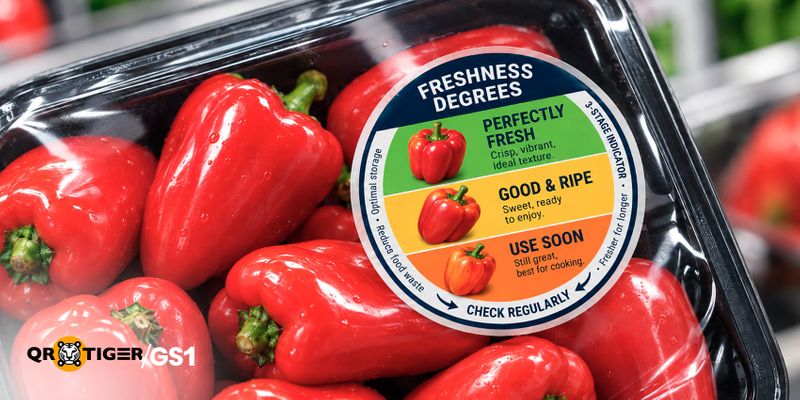
Intelligent packaging detects, monitors, or reports information about a product or its condition.
It provides information that can help manufacturers, retailers, or consumers make decisions about the product.
Intelligent packaging can use visual indicators, color-changing labels, printed sensors, chemical indicators, or electronic sensors.
The technology can monitor things such as temperature, freshness, gases, package integrity, or other changes that may affect a product.
1. Environmental History and Freshness Indicators
Some intelligent packaging records the conditions a product has experienced. Others use these conditions to indicate freshness or remaining shelf life.
Samples:
Timestrip PLUS is a commercial time-temperature indicator. It records the cumulative time a product has spent above a defined temperature threshold and shows the result through a visible color change. Timestrip says its indicators are used for food, pharmaceutical, and logistics applications.
Another type of indicator focuses on freshness rather than simply reporting a temperature breach. Insignia Technologies' FreshTag changes color based on the conditions experienced by the product and can be configured for different product life cycles. It provides a visible indication of how much time remains before the product reaches the end of its freshness period.
2. Atmosphere and Spoilage Indicators
Some intelligent packaging detects changes in the gases inside a package.
These gases can provide information about the condition of the product or the atmosphere around it.
Examples include oxygen, carbon dioxide, ammonia, and other gases associated with product deterioration.
Ageless Eye, from Mitsubishi Gas Chemical, is an oxygen indicator used inside packaging. Its color changes according to the oxygen level, providing a visible indication of whether an oxygen-free environment has been maintained. Commercial and academic sources identify it as an example of an in-package gas indicator.
Gas indicators can also be designed to detect gases associated with spoilage. For example, some freshness sensors respond to volatile compounds produced as food deteriorates. These indicators provide information about the product's condition rather than changing the package environment.
3. Package Integrity and Tamper Indicators
Intelligent packaging can also indicate whether a package has been damaged, breached, or exposed to conditions that may affect its protective barrier.
Novas, from Insignia Technologies, is an example of an integrity indicator for products packed in a modified atmosphere. The technology uses a color-changing pigment in the packaging material to show when the package has been damaged and its protective atmosphere has been compromised.
This type of technology helps identify a package problem without requiring the package to be opened or inspected manually.
Connected Packaging
Connected packaging links a physical product or package to digital information or services.
The connection can be created through 2D barcodes, NFC, or RFID. Most connected packaging links to digital content that applies to an entire product line or batch. In contrast, intelligent packaging provides specific information unique to one individual item.
While these technologies all connect a product to digital information, they differ in how that connection is made and how the product is read.
1. NFC
Near Field Communication (NFC) connects packaging to digital information through a small NFC tag attached to or built into the package.
An NFC tag contains a chip and antenna. The chip stores information, such as a URL or product ID. Most NFC tags are passive, meaning they do not need a battery. When an NFC-enabled smartphone comes close, its reader creates a magnetic field that powers the tag. The tag then sends its stored information to the phone, which can open a URL or process other data.
NFC began appearing on smartphones in late 2010, became more widely adopted by major smartphone brands from 2014 onward, and is now a standard feature on most smartphones. Apple introduced NFC tag reading through Core NFC in iOS 11 for the iPhone 7 and later.
Sample use case: Kilchoman Distillery uses NFC tags on its whisky bottle labels. Consumers can tap the bottle with an NFC-enabled smartphone to access digital content connected to the product.
2. RFID
Radio Frequency Identification (RFID) connects physical products to digital systems using radio waves.
RFID is a broad family of technologies that includes LF, HF, and UHF. For product packaging and retail, UHF RFID is widely used because it can read tags from several meters away and identify multiple items quickly.
An RFID tag contains a chip and antenna. A reader sends a radio signal to the tag. A passive tag captures energy from this signal to power its chip. The tag then sends its stored data back to the reader using backscatter. The data is often a unique product identifier that a business system uses to retrieve product information.
Unlike NFC, RFID usually requires a dedicated reader.
RFID is mostly used for business and supply chain applications, such as inventory, receiving, tracking, and checkout. It can be used on individual products, cartons, and pallets.
However, some retail systems use RFID for consumer-facing product information. For example, Catalyst Smart Screen can detect an RFID tag attached to a garment. When the garment is brought near the screen, the system identifies it and displays product information and related products.
3. Linked 2D Barcodes
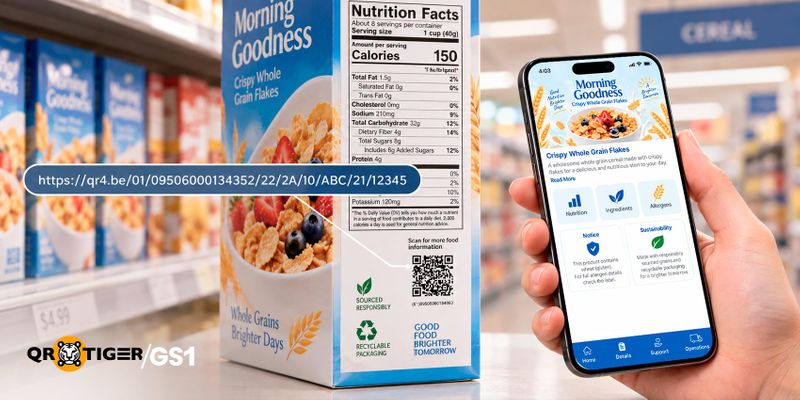
QR Code is a common 2D barcode format used to connect packaging to online information. The connection is made by encoding a web address in the QR Code, which a smartphone can read and open.
There are two common approaches:
Website URL in a QR Code: A regular website URL is encoded in the QR Code and directs the user to a webpage.
GS1 Digital Link URI in a QR Code: A GS1 Digital Link URI is encoded in the QR Code. It follows GS1's standardized syntax and includes a GS1 identifier, such as a GTIN, to connect the identified product to online information or services.
Editorial Take: Some sources count interactive packaging as a type of smart packaging. We do not. If “interactive” refers to interaction with online content, this is already covered under connected packaging. If it refers to features that require the user to interact directly with the physical package, such as pulling tabs, peeling off game pieces, or folding the pack into a toy, these features may improve the user experience, but they do not act on the product, monitor its condition, or provide product information. Therefore, we do not classify them as smart packaging. |
What Is Not Considered Smart Packaging
There are other packaging methods and processes that are not considered smart packaging. This does not mean these features are not useful. They offer important benefits, but they do not fit the definition of smart packaging.
1. Passive Protection and Barrier Formats
- Conventional barrier packaging: Cartons, glass bottles, cans, and barrier films protect products from physical damage, moisture, oxygen, light, or other outside factors.
- Passive modified atmosphere packaging (MAP): A set gas mixture, such as nitrogen, is added during packing and does not change in response to the product afterward.
- Vacuum packaging and vacuum skin packs: Air is removed from the package to reduce oxygen exposure and help protect the product.
- Aseptic packaging, retort pouches, and cans: These packages keep food safe and long-lasting because of how the food is processed (heated or sterilized) and then sealed.
- Insulated or thermal packaging without monitoring: Materials such as EPS boxes and insulated mailers help maintain temperature but do not measure or report it.
2. Sustainability and Material Attributes
- Biodegradable, compostable, recyclable, reusable, and refillable packaging: These features affect how packaging is made, used, or disposed of rather than monitoring or communicating product information.
- Lightweight, bio-based, or recycled-content packaging: These materials reduce packaging weight or change its material source without adding a smart function.
3. Design, Structure, and Mechanical Convenience
- Ergonomic or novelty shapes and premium finishes: These features change the package's appearance, handling, or presentation without adding a smart function.
- Convenience features: Resealable zippers, easy-pour spouts, easy-open tabs, child-resistant closures, and mechanical dosing caps make products easier or safer to use.
- Portion-control and multipack formats: Sachets, blister packs, and break-apart trays divide products into smaller portions or units.
- Standard microwaveable or ovenable trays: Heat-resistant materials allow the package to withstand heating but do not actively heat the product.
4. Security and Tamper-Evident Features
- Passive visual security features: Holograms, microtext, watermarks, and UV-visible inks help identify genuine packaging but do not digitally verify the product.
- Mechanical tamper-evident seals: Break-away rings, shrink bands, and void tape show visible signs when a package has been opened or tampered with.
How Smart Packaging Works Together
The goal of smart packaging is to help products stay in good condition so they can be consumed at their best, even under different conditions. It can also help reduce food waste by helping protect products, monitoring their condition, and providing useful information.
The three types of smart packaging can work together to support this goal.
However, not every product needs every type of smart packaging. Look at each process and consider how it can help your product. Does the added cost provide enough value in the long run? Could a longer shelf life reduce waste or improve your profits?
These are the questions to ask before deciding whether smart packaging is right for your product.
Frequently Asked Questions
What is product packaging?
Product packaging is the material or container used to hold, protect, store, transport, and display a product. Examples include bottles, boxes, cans, pouches, and wrappers.
What are the types of packaging materials?
Common packaging materials include paper, cardboard, plastic, glass, metal, wood, and fabric. Some packaging uses more than one material.
What is a packaging level?
Packaging levels describe the layers of packaging around a product:
- Primary packaging: Directly holds the product, such as a bottle or can.
- Secondary packaging: Holds or groups primary packages, such as a box of bottles.
- Tertiary packaging: Holds groups of products for shipping, such as a pallet or large shipping container.
What is the difference between packaging and packing?
Packaging is the material and container used to hold and protect a product. Packing is the process of putting products into packaging and preparing them for storage or shipping.

DISCLAIMER: We acknowledge that GS1, as well as the materials, proprietary items, and all related patents, copyright, trademark, and other intellectual property (collectively, “intellectual property”) relating to its use, are the property of GS1 Global, and that our use of the same shall be in accordance with the conditions provided by GS1 Global.
