
GS1 Argentina: Standardizing Data for Business Support

Argentina’s supply chains face real challenges. The country produces large amounts of agricultural goods like beef, dairy, and soy. These products often travel long distances, both within the country and for export. At the same time, retail depends on a steady supply of packaged food, drinks, and everyday household items.
GS1 standards help bring order to this process. GS1 Argentina (AR) provides a system for identifying products using global standards like GTINs and barcodes. These codes make it easier to recognize products at every step, from production to the store.
With these standards, businesses can label products clearly, manage inventory better, and share product information with partners. This helps reduce mistakes, improve tracking, and support compliance with retail and government requirements.
This blog looks at the GS1 member organization’s(MO) services, the regulations and programs it supports or participates in, and real examples of how these are used by businesses across industries. It also looks at how GS1 is promoting the use of 2D barcodes for product and logistics identification.
What is GS1 Argentina?
GS1 AR is a neutral, non-profit organization that promotes and supports the adoption of global identification standards to help Argentine businesses across all industries communicate and operate more efficiently throughout their supply chains.
Its most vital function is licensing the GS1 Company Prefix, which serves as the fundamental building block for all product identification and barcodes.
Contact information:
Address: Fraga 1326, C1427BUB Buenos Aires, Argentina
Contact no: + 54 11 4556 4700
Email: info@gs1.org.ar
GS1 AR History
In the early 1980s, Argentine supermarkets had a problem: tracking products on shelves and at checkout was done by hand, which was slow and full of mistakes.
In 1984, the Cámara Argentina de Supermercados took action. They created an organization called CODIGO, whose job was to bring the barcode system to Argentina. The country was assigned the prefix 779, which would appear on every Argentine product barcode.
The first test came quickly. A company called Llauró e Hijos put a barcode on its Duplex laundry detergent, the first mass-market product in Argentina to carry one. It was a small moment that would change commerce forever.
Through the 1990s, CODIGO kept growing. Pharmacies joined the system, medicines got barcodes, and businesses began exchanging information digitally for the first time. Later, an electronic product catalog was launched, making it easier for suppliers and supermarkets to share accurate product data.
In 2005, a big global change happened: the two major international barcode organizations merged into one, and the name GS1 was adopted worldwide. CODIGO became GS1 Argentina.
Supported initiatives and collaborated campaigns
GS1 AR works alongside industry partners to help adopt global standards that support digital transformation and increase supply chain efficiency.
ANMAT
In 2011, Argentina took an important step to make medicines safer and protect patients. The National Administration of Drugs, Foods and Medical Devices (ANMAT) set up the National Medicines Traceability System and chose GS1 global standards as the technical base.
It started with Disposición 3683/2011, which required every part of the supply chain, from manufacturers to pharmacies, to track high-risk medicines at the unit level. Instead of tracking only bulk shipments, each box of medicine had to have a unique serial number. To do this, the industry used the GS1 DataMatrix, a 2D barcode that stores the product’s GTIN, batch number, expiration date, and serial number in a small square.
As the system worked well, ANMAT gradually expanded it. Disposiciones 1831/2012, 247/2013, and 10564/2016 added more medicines under mandatory traceability in stages. In 2014, the same rules were applied to medical devices, covering high-risk items like pacemakers and stents.
Today, the collaboration with ANMAT is one of the most complete medicine tracking systems in Latin America. Using shared global standards, every medicine can be traced from the manufacturer to the patient, helping make sure what reaches the shelf is safe and correct.
SENASA Mandatory Traceability (2013)
Argentina introduced mandatory traceability for phytosanitary products (agrochemicals like pesticides and herbicides) and veterinary medicines under SENASA(National Service for Agri-Food Health and Quality). The goal was to track these products through the supply chain, from manufacturers to distributors and retailers, ensuring safe use and preventing counterfeit or mislabelled items.
Each product must carry a unique identifier, enabling regulators and businesses to trace its origin and movement. This helps improve safety, maintain product quality, and comply with regulatory standards.
In terms of technical standards, SENASA chose GS1 standards, specifically the GTIN for product identification and the GLN for identifying physical locations. Tracking of each unit is carried out using linear GS1-128 or DataMatrix codes.
Since its introduction, SENASA’s traceability program has helped protect farmers, livestock, and consumers, while supporting compliance with national and international regulations.
Provincial Agreements for SMEs
Provincial Agreements for SMEs are special programs that help small and medium businesses grow by using barcodes. GS1 AR works with local governments and ministries to create these alliances, giving new members access to up to 10 barcodes with special benefits.
To get the benefit, small and midsize enterprises (SMEs) in provinces with agreements need to show proof from the Ministry that they are registered, sign up with GS1 AR, and attach the provincial receipt. This makes it easier for regional businesses to join GS1 and operate more efficiently.
GS1 AR services for businesses
Tools and services from GS1 help businesses work more efficiently and innovatively.
Identification Codes
Companies in Argentina register and license a Company Prefix from GS1 AR. This prefix works like a global ID card for the business. With it, they can create codes that identify products, locations, and shipments across the supply chain.
The prefix is used to build three key codes.
GTIN (Global Trade Item Number; it is a product ID scanned at checkout and used for stock tracking), GLN (Global Location Number; it is a location ID that ensures invoices and deliveries go to the right place), and SSCC (Serial Shipping Container Code; it is a shipment ID like a license plate for pallets or containers that simplifies tracking goods as they move).
EDI (Electronic Data Interchange)
GS1 EDI is the standard used for the computer-to-computer exchange of business documents between companies. In Argentina, GS1 AR provides this service to replace manual processes, like phone calls, emails, or paper forms, with automated, digital messages.
The primary goal is to allow different computer systems (like an ERP used by a supermarket and a different one used by a supplier) to "talk" to each other in a common language. Instead of a person manually typing an order into a system, the systems exchange the data directly.
The service makes it easier for companies to share documents and messages with their trading partners by standardizing data formats to improve speed and accuracy.
It provides key benefits like lower process expenses, reduction in paper usage, faster and more accurate data handling, and simpler transactions. Common documents it handles include purchase orders, receipts, invoices, dispatch notices, and remittances.
NegociAR
GS1 NegociAR is a free digital platform for GS1 members. It connects suppliers, especially small and medium-sized enterprises (Pequeñas y Medianas Empresas - PyMEs), with supermarkets and large retailers across the country.
Its goal is to help local producers reach larger buyers. Suppliers can showcase their products through a digital catalog and respond to product requests from retailers. Retailers can search for products, post their needs, and communicate directly with suppliers through the platform.
By providing a direct and centralized space for both sides, GS1 NegociAR helps businesses connect faster, access new opportunities, and expand their market reach
In short, while EDI handles the technical documents once a deal is made, NegociAR is the tool used to find the partner and make the deal happen in the first place.
OSA (On Shelf Availability)
OSA GS1 has been an in-store audit service since 2017. It helps companies improve product availability by checking if items are actually present on retail shelves.
GS1 teams visit stores regularly and search the aisles for products selected by the companies that hire the study. If a product is found on display, it is recorded as available, along with details such as price, batch number, and expiration date.
If a product is not found, it is marked as missing and assigned a specific cause based on on-site analysis. This allows companies to understand why stockouts happen and take more focused actions to improve availability while managing resources more efficiently.
Results are shared through channels such as WhatsApp alerts, Power BI dashboards, and periodic reports.
OSA+: Launched in 2024, OSA+ is an enhanced version of the OSA study that adds image recognition and AI to the data collection process. During store visits, auditors capture shelf images using a mobile device. These images are then processed through a system developed in partnership with Rebrain to extract additional product insights.
OSA+ makes it possible to measure key metrics such as out-of-stock items, price, number of facings, and share of shelf for each product and brand. Automating part of the analysis, it allows auditors to collect more data in less time, improving both efficiency and the level of detail available to companies.
GS1 TrazAR
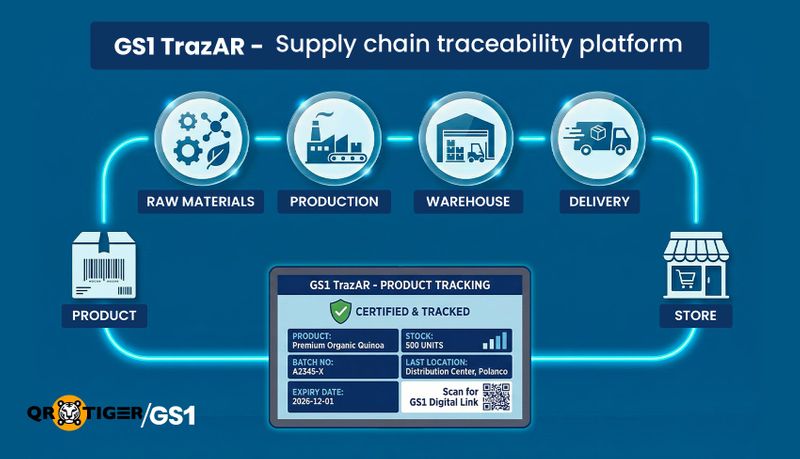
Every product follows a path. It begins with raw materials, moves through production, and ends with the final customer. Traceability is about clearly capturing that path, step by step.
TrazAR is GS1 Argentina’s platform built for this purpose. It records a product’s full history. From the receipt of raw materials, through manufacturing, up to the dispatch of finished goods. Key data, such as stock levels, batch numbers, and expiration dates, is stored in a single secure system.
What sets TrazAR apart from a typical tracking system comes down to its foundation.
It is built on GS1 global standards. These standards act as a shared language across industries, retailers, and regulators worldwide. Because of this, the data is not confined within a single company. It can be shared across supply chain partners in a consistent and reliable format, without the need for custom adjustments.
The benefit becomes clear in critical situations. During a product recall, a quality issue, or an audit, companies can respond with precision. They can identify the affected batch, trace its origin, and determine where it has been distributed.
TrazAR does more than indicate a product’s location. It provides a standardized and verifiable record of its entire journey. One that every participant in the supply chain can depend on.
Verified by GS1
Verified by GS1 is a global service that allows retailers and marketplaces to confirm whether a GTIN is valid and licensed to the correct company. It uses GS1’s global registry to match product identifiers with trusted company data.
This helps businesses verify product information, check GTIN ownership, and ensure consistency across trading partners. As a result, companies can reduce data errors and improve the accuracy of product listings across systems
Code Verifications
Code Verification helps make sure 1D and 2D barcodes can be read correctly at checkout. Poor print quality can cause delays or errors, so GS1 offers services to check and improve your codes.
You can use Pre‑verification to identify problems before printing, or Verification to fix issues after packaging is ready. Pre‑verification can be done by sending a sample image, whereas verification gives you an official certificate that confirms your codes meet reading standards.
DATA. COD
Data.Cod is a digital catalog in Argentina that allows companies to share and sync product information with their business partners online. It helps ensure that everyone in the supply chain, from manufacturers to supermarkets, is working with the same data.
It is mainly used by companies in Argentina, especially those in consumer goods and retail, that need to share reliable product information with supermarkets and distributors.
It works as a central database where companies upload both technical and commercial product details. Once a product is added, any updates, such as changes in weight, size, or description, are automatically shared with all connected partners.
This system helps
- Keep logistics and commercial data consistent between suppliers and retailers.
- Reduces errors by eliminating manual data entry, preventing mistakes in orders and invoices.
- Saves time by speeding up the process of launching new products.
- Improves logistics by providing accurate product dimensions for better warehouse and transport planning
Applications of 2D barcodes across industries in Argentina
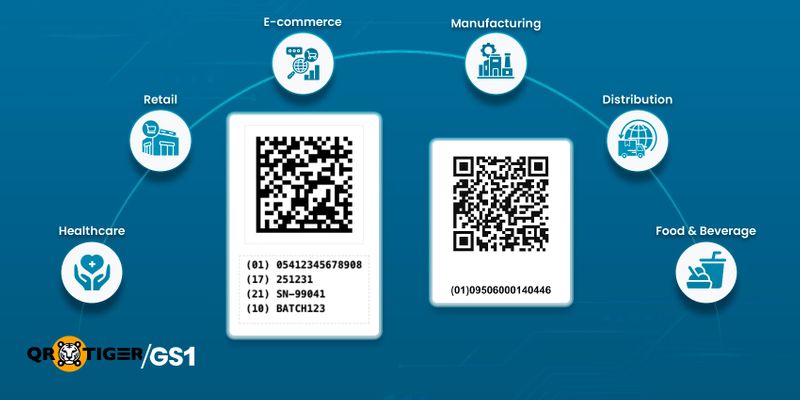
Retailers will increasingly adopt smarter product labels powered by 2D barcodes by 2027. Unlike the familiar 1D versions, these next-generation codes hold far more data. This enables better product visibility and deeper customer interaction.
GS1 Sunrise 2027 initiative supports this evolution. It aims to make shopping experiences more transparent and efficient across both physical and digital channels. The move is not compulsory yet; industries can continue using 1D barcodes where regulations allow.
To simplify the transition, many businesses are encouraged to use dual labeling (printing both 1D and 2D barcodes on packaging. This approach makes sure existing systems remain functional while preparing for future retail innovations.
Businesses preparing for Sunrise 2027 have two clear paths. They can either generate GS1-compliant 2D barcodes in-house by following GS1’s official guidelines or use trusted third-party platforms such as QR Tiger’s GS1 QR code generator.
For companies that are short on time or technical expertise, these external solutions offer a quick and reliable way to generate and apply next-generation barcodes. This makes the transition far smoother.
Here are key applications of these barcodes across industries in Argentina:
Retail
GS1 2D barcodes, such as GS1 QR codes, give users access to far richer product data than traditional 1D codes. A single scan can reveal batch numbers, expiry dates, serial identifiers, sustainability claims,and more that enables smarter inventory practices.
The use of these codes make sure unsafe items don’t reach consumers. They also improve inventory accuracy in this sector.
Healthcare
In the healthcare and pharmaceutical supply chains, GS1 DataMatrix is the standard for medicines and medical devices, including those regulated under UDI (Unique Device Identification) systems. These compact codes carry critical identifiers (such as batch number and serial number, and expiry date) to ensure traceability and authenticity.
Hospitals and pharmacies use them to match the right medicine or device to the right patient record, track inventory in real time, and quickly respond to recalls. This supports patient safety and counterfeit prevention.
Food and Agriculture
Producers and exporters use GS1 Digital Link QR code to packaged food and agricultural products. These codes store batch and expiry details, enabling traceability from harvest or processing through to retail shelves.
Scanning them provides visibility into nutrition values, allergen warnings, and certifications, while also supporting faster recalls and better stock rotation. This reduces food waste, ensures fresher products reach consumers, and builds global trust in Argentina’s food exports.
Distribution
Logistics providers use GS1’s Scan4Transport standard, which encodes the Serial Shipping Container Code (SSCC) into 2D barcodes. Each pallet, carton, or container receives a unique SSCC, allowing systems to instantly retrieve shipment IDs, delivery addresses, handling instructions, and product compliance notes.
Even if systems are offline, essential delivery data can be embedded directly in the barcode, ensuring continuity of operations. This reduces delays, minimizes errors, and supports accurate, efficient movement of goods across Argentina’s diverse geography.
Inspiring success stories from GS1 in Argentina
GS1 AR helps businesses improve product visibility, safety, and efficiency. These case studies show how GS1 standards make supply chains more efficient.
CBSé
CBSé is an Argentinian company known for its organic yerba mate beverages. It needed to meet international regulations and give customers full visibility into its supply chain. To achieve this, the company approached GS1 AR to adopt the GS1 Global Traceability Standard (GTS).
With GS1’s support, CBSé introduced a standardized system that tracks every stage of production (from receiving leaves to preparing and shipping finished products). By using GS1 identification codes and data capture processes, CBSé can now guarantee product traceability across all plants.
It helps comply with global trade requirements and also builds consumer trust in Argentina and abroad.
Results:
- Faster recalls: Issues are identified quickly, which makes recalls easier and more effective.
- Real-time tracking: Instant data helps identify problem batches and act fast.
- Supply chain visibility: Centralized systems show where products are at every stage.
- Efficiency improvement: Better data improves operations and builds customer trust.
Alfajores El Molle
Alfajores El Molle, a small family-owned business in Tilcara, Jujuy, produces handmade alfajores in many flavors. The company needed a system to manage its many alfajor flavors while meeting food safety rules. It also wanted certifications to show customers its strong commitment to quality and safety.
With guidance from GS1 AR, the company introduced GS1 barcodes and identifiers to uniquely label each flavor and shipping unit.
Using the GS1 TrazAR platform, they digitalized data collection that made it possible to track products from raw materials to final dispatch. This gave them real-time visibility into their stock and supply chain.
El Molle can now easily trace ingredients, packaging, and shipments, and also helps the team use resources more wisely.
Results:
- Enables digital data and automated processes.
- Keep all information in one place.
- Builds a culture focused on food safety.
- Improves control of suppliers and stock.
Empowering Supply Chains with Global Standards
GS1 Argentina supports industries with tools that improve product tracking, efficiency, and compliance. Its services help companies identify products clearly, share accurate data, and build trust across supply chains.
By joining GS1, companies get access to trusted standards and expert support that link them to the global GS1 network. This helps Argentine businesses trade and track products more easily worldwide.
FAQs
What prefix does GS1 AR issue for barcodes?
GS1 AR issues GS1 Company Prefixes starting with 779. These prefixes form the foundation for creating globally unique identifiers like GTINs, GLNs, and SSCCs. They ensure that your product codes are recognized globally.
How does GS1 connect businesses globally?
By registering with GS1, companies get access to the global GS1 network. This allows them to integrate smoothly into international supply chains. Products become easier to trade, track, and verify worldwide. That advantage helps businesses stay competitive in the market.
Does GS1 offer training or support for businesses?
Yes, GS1 provides a wide range of support to help companies use its standards confidently. Businesses can access step‑by‑step guides, online courses, and assistance from experts.
These resources show how GS1 standards work, make them simple to apply, and help companies benefit from accurate product data in daily operations.

DISCLAIMER: We acknowledge that GS1, as well as the materials, proprietary items, and all related patents, copyright, trademark, and other intellectual property (collectively, “intellectual property”) relating to its use, are the property of GS1 Global, and that our use of the same shall be in accordance with the conditions provided by GS1 Global.
