
GS1 Indonesia: Standardizing Data Sharing and Trade

In a country as large and spread out as Indonesia, moving goods can be difficult. With thousands of islands and different levels of infrastructure, keeping the supply chain consistent is not always easy.
GS1 standards provide a shared system for identifying, tracking, and tracing products. This helps businesses manage goods more accurately as they move from one place to another.
By using these standards, companies can reduce errors and improve visibility. It becomes easier to coordinate with partners, even when products travel long distances.
For many businesses in the country, GS1 Indonesia (ID) is more than just helpful. It brings order and clarity to supply chains that could otherwise become hard to manage.
This blog discusses how GS1 ID helps businesses use barcode standards and move toward digital tracking. By doing this, supply chains become more transparent, safer, and better prepared to compete in today’s global market.
What is GS1 Indonesia?
GS1 ID is the official GS1 Member Organization (MO) responsible for issuing GS1 Company Prefixes for businesses operating in Indonesia. Founded in 1993, it issues refixes that start with 899. This is a building block in creating GS1 identifiers for products, locations, logistics units, and other assets for tracking, management, and trade, locally and internationally.
The MO provides tools, training, guidance, and support to implement GS1 standards across the Indonesian market. It currently serves more than 7,000 member companies across multiple sectors.
Contact information:
Address: Talavera Office Park (Office Building) 5th floor, Unit 02-03, JI TB Simatupang Kav 22-26, 12430 Cilandak Barat, Indonesia
Contact no: +62 21 22976500, +62 21 27826910, +62 21 27826912, +62 21 27826914
Email: info@gs1id.org
Introduced Initiatives, Collaborated or Supported Campaigns
GS1 ID collaborates with industry leaders to support digital transformation and improve supply chains.
BPOM Regulation No. 22/2022 and the TTAC System
BPOM Regulation No. 22/2022 sets the rules for product traceability in Indonesia. It mainly applies to pharmaceuticals and certain food products.
The regulation requires companies to place GS1 2D barcodes on their products. These barcodes store key details such as product identity, batch number, and expiration date.
This connects to the Track and Trace Anti-Counterfeit (TTAC) system, which allows authorities to track products and check if they are authentic.
National Logistic Ecosystem (NLE)
The National Logistic Ecosystem (NLE) is a government program that connects logistics services into one system.
It links customs, ports, transport providers, and businesses. The goal is to make the flow of goods faster and more transparent.
Instead of working in separate systems, stakeholders can share data more easily.
Halal Traceability
Halal traceability focuses on tracking products to make sure they meet halal requirements.
This includes checking raw materials, production processes, and distribution. It helps ensure that products remain halal from start to finish.
Traceability is becoming more important as businesses need to show proof, not just certification.
STELINA - World's First GDST-Compliant National Seafood Traceability System
Indonesia has launched the world’s first national seafood traceability system that follows the Global Dialogue on Seafood Traceability (GDST) standard. The system, called STELINA, tracks seafood from fishing boats and farms to the final market.
It works by using global identification standards and a shared data system. These allow businesses to label products and locations consistently, making it easier to share information across the supply chain.
With support from GS1 ID, seafood businesses, including fishers, processors, and exporters, can participate in this system. This helps ensure products can be traced properly and meet international requirements.
This is important for exports. Products like shrimp, tuna, and crab are often sent to markets like Europe and the United States, where traceability is expected. By meeting these requirements, Indonesian seafood businesses can continue to access global markets and stay competitive.
GS1 ID services for businesses
By providing tools and services, GS1 enables businesses to work more efficiently and support innovation.
Getting Product Identification Codes
Every product needs a unique identity to be recognized in stores, online, or across the supply chain. GS1 ID provides services that make this possible.
The main service is issuing identification codes like the GTIN (Global Trade Item Number). This number is the key behind barcodes that appear on products.
Here’s how it works:
- Company Prefix Registration – The organization assigns a unique prefix to a company. This prefix identifies the manufacturer or brand owner.
- GTIN Allocation – Using the prefix, companies can assign unique numbers to each of their products. Each variation, like size or flavor, gets its own GTIN.
- 1D Barcode Creation – They provides the standard format so companies can generate barcodes that scan correctly in stores and systems.
- Standards Guidance – They also guide businesses on how to apply GS1 standards to packaging, logistics labels, and digital platforms.
Links to GS1 Global Tools
GS1 ID provides links to key GS1 global tools hosted on the main GS1 website.
- Verified by GS1 – Checks if a GTIN matches the correct product and company.
- Check Digit Calculator – Verifies that GTINs are properly formatted to prevent scanning or data errors.
- GPC Browser – Classifies products according to the Global Product Classification (GPC) standard for consistency in international trade.
Barcode Verification
Barcode verification helps avoid losses caused by printing mistakes or unreadable codes at retail checkout. It makes sure that every product’s number is correctly shown in the barcode. This allows point of sale (POS) systems to work smoothly without errors.
To begin the process, businesses first complete a registration form and meet the requirements. The next step is to submit a sample product or final artwork design for verification.
Product Photo
This service helps companies create high-quality product images that are ready for retail and e-commerce. The images follow GS1 standards, so they can be used across different platforms without issues.
What the service includes:
Standard Product Shots: Photos of all six sides of a product. Front, back, left, right, top, and bottom. These are used for retail planning, like how products are arranged on shelves.
Marketing Images: Clean and attractive images, including angled “hero shots.” These are used for websites, mobile apps, and online listings.
Information Capture: Close-up photos of important details on the packaging. This includes nutrition facts, ingredients, and barcodes. Everything is clear and readable.
Image Editing: Backgrounds are removed and replaced with a plain white background. This meets standard image requirements for retail and e-commerce.
System Integration: Images are named using the product’s GTIN. They are then uploaded to the GS1 ID database and may also be used in platforms like BPOM systems.
Training Programs
GS1 ID provides training programs to help businesses understand how GS1 standards work. These sessions are available to both members and non‑members. They guide companies on applying GS1 Keys in daily operations and support business growth.
There are three types of training available. The Basic Training covers features such as creating barcodes for packaging, preparing outer boxes, and entering product data into the GS1 ID Online Product Registration (RPO) system. This program is free for members, whereas non‑members pay a small fee.
Advanced Training and In‑house Training are available for in-depth learning. Advanced Training focuses on the practical use of GS1 Keys, barcodes in distribution, packaging, production control, and Global Location Numbers (GLN).
In‑house training is useful for companies that want to have sessions conducted at their offices or warehouses. It allows employees to learn and implement GS1 standards in their everyday work.
Businesss Consultation
The service allows members to talk directly with GS1 experts about barcode-related challenges. These sessions can be conducted online through Zoom or in person at a mutually agreed location. With this service, businesses get flexible options to get the guidance they need.
Applications of 2D barcodes across industries in Indonesia
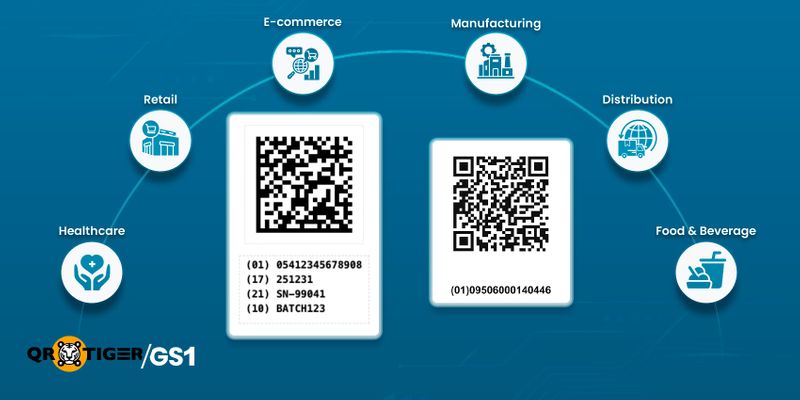
GS1’s Sunrise 2027 initiative is a global effort to prepare retail systems to scan 2D barcodes, like QR codes powered with GS1, at checkout.
These codes can store more product information, which helps improve product tracking and can link shoppers to digital content such as product details, promotions, or usage information.
1D barcodes will continue to be used, but many companies are already starting to prepare for 2D barcode adoption.
Businesses can either create GS1‑compliant 2D barcodes by following GS1’s official instructions or use partner solutions like QR Tiger’s GS1 QR code generator.
Here are key applications of these barcodes across industries in Indonesia:
Retail
Retailers can scan GS1 QR codes on products to access detailed information instantly, such as batch numbers, serial numbers, and expiry dates. This enables them to implement FIFO(first-in-first-out), prioritize items nearing expiration for promotions, or trigger automated system responses.
For example, if a recalled product is scanned, the system can flag it immediately, preventing it from being sold. This capability supports safer operations, more accurate inventory control, and timely restocking decisions.
Healthcare
In the healthcare and pharmaceutical sector, GS1 DataMatrix codes are used for detailed product identification and for medical devices under UDI systems.
Scanning these codes helps hospitals and pharmacies track medicines and devices. By linking the scanned product to the patient record, they can ensure the right medicine or device and the correct dose or usage. It also helps track device location, manage inventory, and quickly respond if a product needs to be recalled.
Distribution
Logistics service providers use GS1’s Scan4Transport standard to encode the Serial Shipping Container Code (SSCC) in 2D barcodes. The SSCC uniquely identifies each pallet, carton, or container. When scanned, connected systems can provide shipment IDs, delivery addresses, handling instructions, and compliance notes.
The code can also be set up to include key delivery data, so if the system is offline, that information can still be accessed. This allows operations to continue, helps ensure shipments are handled correctly, reduces delays, and prevents errors in tracking or processing.
Food and Agriculture
Once products are packaged, 2D barcodes can store details like batch numbers and expiry dates. This allows producers and distributors to identify when an item was harvested or processed.
When scanned, this information helps track products through the supply chain with better accuracy. It supports faster recalls when needed, reduces food waste by managing products close to expiration, and improves overall quality control. Teams can also make quicker decisions on stock handling, ensuring fresher products reach shelves.
Inspiring Success Story: Youmau Coffee
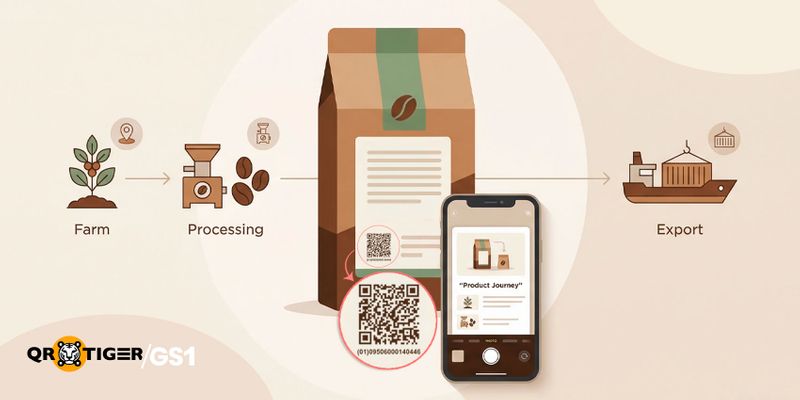
Youmau Coffee, a small business from Tangerang, processes premium Indonesian coffee. By working with GS1 ID, they became one of the first local businesses to start using QR codes powered by GS1.
Their goal was to move beyond a simple barcode and create a "digital story" for their products. They implemented this system so customers could scan a single code to see the coffee’s journey, from the specific farm where the beans grew to the final production and safety details.
The project has been a major success. By providing this "farm-to-cup" transparency, Youmau Coffee has built strong trust with international buyers. They have proven that even small businesses can use global standards to compete in the export market and share the story of Indonesian coffee with the world.
Building Smarter Supply Chains with Global Standards
The global standards provided by GS1 Indonesia help businesses across industries with simplified product identification, tracking, and data management. Its tools and services help Indonesian companies work more efficiently, stay transparent, and follow EU sustainability rules with ease.
As part of the global GS1 network, it connects local businesses to international supply chains. This approach helps them stay competitive. By joining GS1, companies get practical tools and expert support that make it easier to track products, stay transparent, and earn customer trust.

FAQs
How are GTINs used to help companies to process products efficiently?
GTINs can be encoded in barcodes or EPC/RFID tags. When scanned, they help businesses handle product details quickly and accurately. For example, the use cases can be during store checkout, when goods arrive at a warehouse, or when giving medicine in hospitals.
Can a barcode from a discontinued product be reused for a new product?
Once a barcode number is printed on packaging and sold in the market, it cannot be reassigned to another product. This means barcode numbers from discontinued products cannot be reused for new ones.
How long do barcodes remain in the market after GS1 Indonesia membership ends?
After the official termination of GS1 membership, barcodes remain in the market for up to 6 months.

