
What Is a GTIN? Structure, Types, and When to Get a New One

TL;DR
|
GTIN stands for Global Trade Item Number. It is a unique number used to identify a product, service, or other trade item as it moves through the supply chain and retail.
Think of it as a product’s unique ID. It helps businesses, retailers, and systems identify exactly what an item is, regardless of where it is sold or handled.
The unique identifier helps businesses keep product information clear and consistent across different systems. It can be used for tasks such as ordering products, managing inventory, setting prices, and sharing product information with retailers and other businesses.
A GTIN can be carried in different forms, including barcode symbols, RFID tags, and NFC tags. These carriers store the GTIN so it can be read by scanners or other devices.
GTIN Structure
A GTIN has three sections, each with a specific purpose: the company prefix, item reference, and check digit.
Company Prefix
A GS1 Company Prefix is a set of numbers that identifies the company that owns the GTIN. It is provided by the company’s local GS1 Member Organization, such as GS1 US, GS1 UK, etc.
The prefix has two parts:
- GS1 Prefix: The first 2-3 digits are assigned by GS1 Global Office. They identify which GS1 Member Organization issued the prefix.
- Company-specific code: The remaining 3-9 digits identify the company.
Together, these form the GS1 Company Prefix. Its length can range from 4 to 12 digits, depending on how many products the company needs to identify. A company with fewer products can have a longer prefix, while a company with more products can have a shorter one.
For example, Tesco Limited has the GS1 Company Prefix 5018374:
501 — GS1 Prefix for GS1 UK, which uses the 500–509 range.
8374 — Company-specific code assigned to Tesco.
The GS1 Prefix does not show where the product was made. It shows which GS1 Member Organization issued the prefix.
The prefix helps make each GTIN unique worldwide. Each company is assigned a different one, so two companies cannot have the same number set.
Item Reference
An Item Reference is a number combination that identifies a specific product from a company. The company assigns this number to each product, and it only needs to be unique within the company’s own numbering system.
The number of digits available sets the maximum number of products the company can identify. For example, if the Item Reference has three digits, it can provide up to 1,000 different combinations, from 000 to 999.
Check Digit
A Check Digit is the final number. It is calculated using the GS1 Modulo 10 algorithm, which uses the other digits to create the final number.
In simple terms, the digits are multiplied by alternating values of 3 and 1, then added together. The check digit is the number needed to make the total a multiple of 10.
Its purpose is to help check if the number has been entered or read correctly. If a digit is changed or entered incorrectly, the check digit will usually show that the number is invalid.
Example of how a GTIN is created
1. Company Prefix: 049000
2. Item Reference: 00935
3. Combined as: 04900000935
4. Check Digit Calculation
Starting from the right, multiply each digit by 3 and 1 alternately:
(5 × 3) + (3 × 1) + (9 × 3) + (0 × 1) + (0 × 3) + (0 × 1) + (0 × 3) + (0 × 1) + (9 × 3) + (4 × 1) + (0 × 3) = 66
Find the next multiple of 10 and subtract the total:
70 − 66 = 4
The Check Digit is 4, giving the complete GTIN: 049000009354
Types of GTINs and Corresponding Barcodes
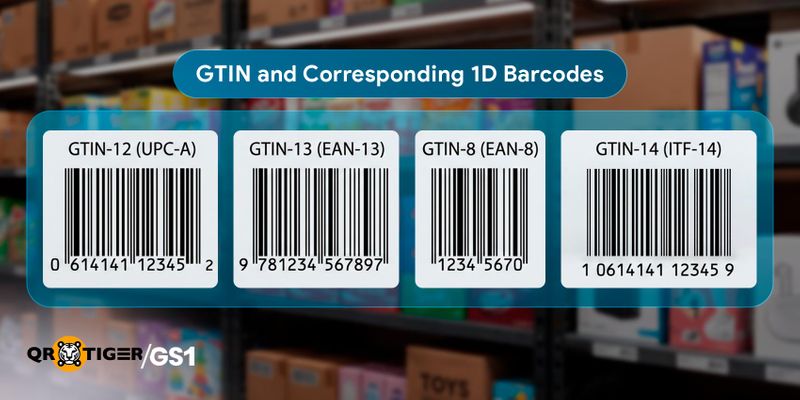
Here is a list of GTINs and the common barcodes that carry them
GTIN-12 and UPC-A barcode
GTIN-12 is a 12-digit format primarily used in North America. It is commonly shown in a UPC-A barcode or is widely known as just UPC.
It was the first open, universal industry standard product code designed for commercial point-of-sale scanning.
GTIN-13 and EAN-13 barcode
GTIN-13 is a 13-digit format used worldwide. It is commonly represented by an EAN-13 barcode, often simply called an EAN.
Compared to a 12-digit UPC-A, the GTIN-13 format adds an additional digit to expand global numbering capacity.
Before 2005, North American retail systems mainly used 12-digit UPCs, while many other markets used 13-digit EANs. This changed with Sunrise 2005, when North American retail systems began supporting GTIN-13/EAN-13 at point-of-sale.
GTIN-8 and EAN-8 barcode
GTIN-8 is an 8-digit format mainly used for smaller products where there is not enough physical space for a longer barcode. It is represented by an EAN-8 barcode.
Unlike GTIN-12 and GTIN-13, a company does not create a GTIN-8 using its regular GS1 Company Prefix. Instead, the company must apply to its local GS1 Member Organization for a GTIN-8.
It uses a GS1-8 prefix and is separate from the company’s regular GS1 Company Prefix. A company cannot use its existing Company Prefix and use it to create a GTIN-8.
Because there are fewer possible 8-digit numbers, GS1 limits GTIN-8 use to products where there is not enough space for a longer barcode.
GTIN-14 and ITF 14 barcode
GTIN-14 is a 14-digit format mainly used for higher-level trade items, such as cases, cartons, and pallets. It is generally not used for standard consumer products sold at retail point-of-sale.
A GTIN-14 is built from an existing GTIN-13, GTIN-12, or GTIN-8. An extra digit is added to the far left. This is called the Indicator Digit,
Indicator Digit has two main uses:
1. Numbers 1–8 identify different packaging levels of the same product.
Example: Coca-Cola may be sold as an individual 330 mL can, a box of 24 cans, or a case containing multiple boxes.
The can keeps its original GTIN, while the box could use Indicator Digit 1 and the case Indicator Digit 2. This lets systems tell each packaging level apart.
2. Number 9 identifies a variable-measure item, where the quantity is not fixed. It requires a barcode that can carry additional GS1 data, such as GS1-128 or a GS1 2D barcode, to include the actual measurement.
Example: A meat processor may ship cartons of fresh beef tenderloin. One carton may weigh 18.42 kg, while another weighs 21.15 kg.
The GTIN identifies the product, while the actual weight is added separately. The GTIN-14 uses Indicator Digit 9, and a GS1-128 barcode can carry the GTIN together with the weight using an Application Identifier such as (310n) for net weight in kilograms.
This allows the barcode to identify both what the product is and how much it weighs.
This is different from the labels printed by grocery stores after weighing meat or other products. Those labels typically use Restricted Circulation Numbers (RCNs) for products sold within a specific retailer or market. They are not GTINs.
How to create GTIN -14 from a GTIN-8, 12, or 13
- Remove the original Check Digit.
- Add leading zeros until 12 digits remain.
- Add the Indicator Digit to the far left.
- Calculate and add a new Check Digit.
Example:
- GTIN-12: 997963214967 — Old Spice Deodorant
- Remove the Check Digit: 99796321496
- Add a leading zero: 099796321496
- Add Indicator Digit 1: 1099796321496
- Calculate the new Check Digit: 4
- GTIN-14: 10997963214964 — 1 box of Old Spice deodorant
*If the Indicator Digit is 2:
Recalculate Check Digit: 1
GTIN-14: 20997963214961 — 1 pallet of boxed Old Spice deodorant.
GTINs in GS1 2D Barcodes
When a GTIN is encoded in a GS1 2D barcode, it uses a 14-digit format. Shorter GTINs are filled with zeros on the left to reach 14 digits.
For example:
- GTIN-12: 997963214967
- 14-digit format: 00997963214967
The GTIN is then placed after the GS1 Application Identifier (01). This tells the scanner that the following 14 digits are a GTIN.
The format can be shown as:
1. Element String: 0100997963214967
2. GS1 Digital Link: 01/00997963214967
The two formats represent the same GTIN. The 01 identifies the data as a GTIN.
Note: 00997963214967 is not a GTIN-14. It is the 14-digit representation of the original GTIN-12. The zeros added to the left are only used to fill the 14-digit format. They are not an Indicator Digit.
When Does a Product Need a New GTIN?
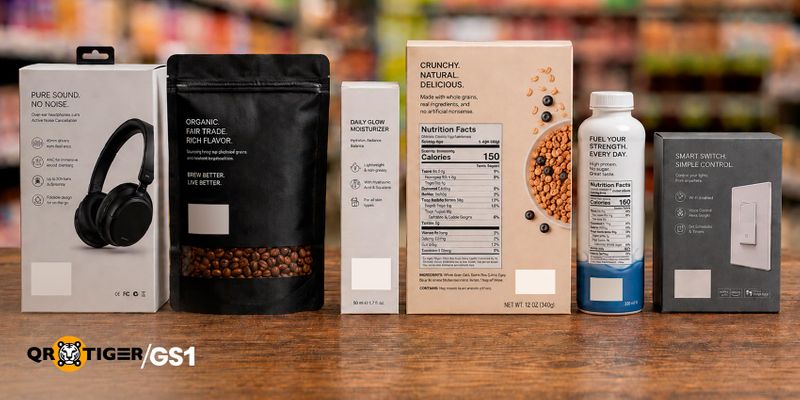
A new GTIN is required when a product is new or when a change meets one of GS1's GTIN Management Rules.
The rules consider whether customers or trading partners need to distinguish the changed product, whether the required information has changed, and whether the change affects the supply chain.
However, Local, national, or regional laws may require a new GTIN in other situations. When they do, those legal requirements take priority over the GS1 rules.
These rules cover general products. Additional rules may apply to specific industries or product types.
If It's a New Product
A new product needs a new GTIN. A product is considered new when it is added as a new or different item to a company's product range.
This can include:
- A new flavor or aroma added to an existing product line.
- A new model with different features or functions.
- A version made for a different language market, such as an English version and a French-only version.
- A seasonal product that customers or trading partners need to order separately.
- Different product styles, colors, sizes, or each combination of the three is sold as a separate product. Under GS1 rules, each variation is assigned its own GTIN. However, in some cases, many clothing brands use the same GTIN across multiple sizes or colors.
- A wine from a different production year may need a new GTIN when the vintage makes it a different product for the consumer. This is common for wines where the year is an important part of the product's identity.
If it has Changes to Packaging Information
A new GTIN may be required when important information printed on the package changes. This includes:
Primary brand — changing the main brand name or logo shown on the product.
Certification marks — adding or removing a mark that shows the product meets a specific standard or requirement.
Price printed on the package — printing a price directly on the package is not recommended. If a price is printed as part of the package design, adding, changing, or removing it requires a new GTIN.
A price added later with a removable sticker, price tag, or hangtag does not require a new GTIN.
Changes to promotional text or artwork do not automatically require a new GTIN if they do not change the product or required product information.
If it has Changes to Ingredients, Components, or Product Use
A new GTIN is required when both conditions apply:
- The change affects information that must legally appear on the product packaging.
- Customers or supply chain partners are expected to recognize the change.
This can include changes to the ingredients, formula, or how the product works.
Examples that fall under the rule:
- A snack product changes from peanut-free to containing peanuts, requiring a new allergen declaration.
- A shampoo formula changes to include an ingredient that requires a different safety declaration.
- A washing machine gains a new function that changes its declared features.
Examples of exceptions:
- A company starts highlighting that a product is recyclable when it already has that feature.
- A product's packaging is redesigned while the product and its required information remain unchanged.
- An existing feature is promoted more prominently without changing the product itself.
Local laws may require a new GTIN even when these conditions are not met. In those cases, the local requirement takes priority.
If it has Changes to Weight or Size
A new GTIN is required when:
- The net weight changes, such as 500 g to 750 g.
- The gross weight changes by more than 20% due to a change in packaging, not the product content. For example, changing a plastic bottle to a glass bottle.
- The product or package size changes by more than 20%, such as its length, width, or height.
Net weight is the weight of the product itself. Gross weight is the total weight of the product and its packaging.
If it has Changes to Product Quantity
A new GTIN is required when the number of products sold together changes.
This includes:
- A retail pack changes from 4 units to 6 units.
- A case changes from 12 products to 24 products.
- A predefined pallet changes from 10 cases to 12 cases.
The rule applies when the products are sold as a defined pack, case, or pallet quantity. Changing the number of products in that package changes what the package represents.
A suggested serving size, such as “serves 4,” does not count as product quantity and is not included in this requirement.
If it has Fixed Product Bundle
A fixed product bundle contains two or more different products that are packed and sold together as one product.
A new GTIN is required if a product in the bundle is added, removed, or replaced.
The products inside the bundle have their own GTINs, while the complete bundle has a separate GTIN.
Example:
A gift set contains shampoo, conditioner, and body wash. If the body wash is replaced with a different product, the gift set needs a new GTIN.

The Future of Product Identification
A GTIN gives a product a unique identity recognized by businesses around the world. It connects the product to the company that owns it and allows retailers, distributors, marketplaces, and other businesses to identify it consistently.
It supports checkout, inventory, supply chain tracking, exports, and e-commerce. As GS1 2D barcodes become more common, they will remain a key product identifier.
Even if a dedicated team manages your product codes, understanding how GTINs work is useful because they affect product setup, packaging, retail systems, and data shared with trading partners. It is a core part of how products are identified throughout the supply chain.
Questions and Answers
Is a GTIN the same as an SKU?
A GTIN can be used as an SKU, but not all SKUs are GTINs.
A GTIN is a globally recognized product identifier used across businesses and supply chains. An SKU is a code created by a business to manage its own inventory and is only recognized within its systems.
Is a GTIN mandatory?
A GTIN is not legally required for every product in every market. However, some retailers, marketplaces, distributors, and trading partners may require one.
If you sell only through your own stores, website, or direct sales channels, you may not need one unless a specific system or partner requires it.
For other sales channels, check their requirements before selling your products.
How do I get a GTIN?
The process depends on the GS1 Member Organization (MO) you register with.
In most cases, you register with a GS1 MO, obtain a GS1 Company Prefix, and use it to create GTINs for your products.
Some MOs, like GS1 Canada, GS1 US, and GS1 Australia, also offer services where businesses can obtain GTINs individually without getting a Company Prefix.

DISCLAIMER: We acknowledge that GS1, as well as the materials, proprietary items, and all related patents, copyright, trademark, and other intellectual property (collectively, “intellectual property”) relating to its use, are the property of GS1 Global, and that our use of the same shall be in accordance with the conditions provided by GS1 Global.
