
Vendor Chargebacks: How It Works and How to Void It

TL;DR:
|
A vendor chargeback is a deduction that a retailer takes from the amount it owes a supplier when the supplier fails to meet agreed-upon requirements. These requirements can include shipping deadlines, packaging standards, product labeling, or required documentation.
Do not confuse it with a customer chargeback. That chargeback happens when a cardholder disputes a purchase with their bank, which may reverse the payment.
Note: Damaged or defective products from the supplier are often handled through separate quality claims, returns, or warranty agreements.
How Does a Vendor Chargeback Work?
It all starts with the Master Vendor Agreement (MVA). This is a contract between a retailer and a supplier. It explains how they will work together, including payment terms, delivery schedules, product requirements, and other business rules.
One section of this agreement is the Vendor Compliance Manual, also called a Routing Guide. You can think of it as a guidebook that tells suppliers exactly how the retailer wants orders to be prepared and shipped.
A vendor compliance manual usually includes instructions for:
- Packaging products and cartons
- Placing product labels and barcodes
- Using approved shipping carriers
- Meeting delivery dates and appointment times
- Matching products with the correct purchase order
- Sending Advance Ship Notices (ASNs), which let retailers know what is arriving before the shipment reaches the warehouse
- Providing the required shipping documents
- Building and wrapping pallets correctly
When a shipment arrives, the retailer checks whether the supplier followed these instructions. If something does not meet the requirements, the retailer records the issue and assesses a chargeback, which is applied as a compliance deduction on the invoice.
The amount deducted depends on the retailer's rules in the MVA and the Vendor Compliance Manual. There is no standard amount because every retailer sets its own policies. Here are sample bases:
| Vendor Chargeback Basis | Real-world Sample |
| A fixed fee for each mistake | Walmart’s SQEP (Supplier Quality Excellence Program) charges a flat $200 per purchase order for a missing or late ASN. Target charges a flat $250 per violation for incorrect or missing EDI transaction sets. |
| A percentage of the invoice value | Home Depot charges 5% of the invoice value for shipments that arrive outside the approved routing guide. Kohl's charges 3% of the invoice value for fill rate violations where the vendor ships below the required fill rate threshold. |
| A fee for each product, carton, or pallet with an issue | Amazon charges vendors a per-unit fee for prep violations, such as items that arrive without required poly bags or suffocation warning labels. Costco charges a per-pallet fee for pallets that do not meet its specific height and weight requirements. |
The actual cost of fixing the problem, such as relabeling products or extra warehouse labor This represents the ‘chargeback" in its purest form: cost shifting. | Macy's charges vendors the actual cost of relabeling merchandise that arrives with incorrect or missing UPC labels, including labor and materials. CVS charges vendors the actual warehouse labor cost incurred when shipments require reworking due to non-compliant inner pack configurations |
The supplier usually receives a notice explaining what went wrong, which rule was broken, and how the deduction was calculated.
In simple terms, the process works like this:
Agreement → Supplier ships the order → Retailer checks the shipment → A rule is broken → The retailer calculates the chargeback → The amount is deducted from the supplier's payment.
Post-Audit Deductions
Not all chargebacks appear on the current invoice. Some retailers conduct audits after invoices have been processed and may identify compliance issues that were missed during receiving.
When this happens, the retailer issues a post-audit deduction, where the amount is deducted from a future payment instead of the original invoice. These deductions can be issued months or even years after the original transaction.
How to Avoid Vendor Chargebacks

These types of chargebacks are preventable. The challenge is that many compliance issues happen long before a shipment reaches the retailer. They often start with outdated instructions, missing data, or small mistakes that go unnoticed until the shipment is received.
1. Following OTIF (On-Time, In-Full)
Measures whether an order arrives within the required delivery window (On-Time) or arrives complete and accurate (In-Full).
It involves the following requirements. Most are easy to understand, but the details are where many suppliers go wrong.
Delivery Windows and Appointment Scheduling: Retailers measure compliance by when a shipment arrives, not when it leaves your warehouse. Missing the delivery window can result in a chargeback, even if the order was shipped on time.
Late deliveries are a common cause, but arriving too early can also be a problem. Many retailers accept shipments only during scheduled appointment times. Early arrivals may be turned away, require rescheduling, or incur extra handling costs, all of which may result in deductions.
To reduce the risk, build enough time for traffic, weather, and carrier delays, but avoid shipping so early that the order arrives before its scheduled delivery window.
Shipping Methods and Approved Carriers: Using the wrong carrier does more than delay a shipment. It can send products through a routing process that the retailer never approved, increasing transportation costs and creating receiving problems.
If your shipping is handled by a third-party logistics provider (3PL), make sure they follow the retailer's routing guide. A supplier can still receive the chargeback even if the shipping mistake was made by another company.
Purchase Order Accuracy: Many purchase order errors happen because information is entered manually into another system. Product quantities, item numbers, and purchase order numbers can all be mistyped.
Using integrated inventory or order management systems helps reduce manual data entry, making these mistakes less likely.
2. Packaging and Carton Specifications
Many suppliers assume that using a sturdy box is enough. It isn't. Retailers often specify the exact carton size, weight limit, and even how products should be packed inside the carton.
A common mistake is continuing to use old packaging requirements after the retailer updates its Vendor Compliance Manual. Review these requirements regularly instead of relying on previous shipments.
3. ASNs and EDI Requirements
An Advance Ship Notice (ASN) is an electronic notice sent before a shipment arrives. It tells the retailer what to expect, including the products, quantities, cartons, and pallets. Many retailers receive ASNs through Electronic Data Interchange (EDI), a standard system for exchanging business documents between companies.
A common mistake is sending the ASN too late or including information that does not match the shipment. EDI documents can also trigger chargebacks if they are sent in the wrong format or contain missing or invalid data.
4. Required Shipping Documents
Electronic documents are only part of the process. The shipment also needs accurate supporting documents, such as the packing slip, invoice, and bill of lading.
These documents should match each other and the shipment itself. Differences in quantities, product numbers, or purchase order numbers often require manual checks, and delay receiving.
5. Pallet Configuration and Handling Instructions
Retailers often have detailed pallet requirements that go beyond stacking products neatly. They may specify pallet size, maximum height, weight limits, stretch-wrap methods, and product placement.
Warehouse teams should use a standard pallet-building process rather than letting each employee decide how to stack shipments. Consistency helps prevent repeated compliance violations.
By the time a retailer issues a chargeback, the mistake has usually happened hours or even days earlier. Regularly reviewing compliance requirements, validating shipment data before dispatch, and standardizing warehouse processes are among the most effective ways to reduce deductions over time.
6. Placing Product Labels and Barcodes
Product label issues are often caused by small details. Labels may be placed in the wrong location, contain outdated information, or not match the purchase order and shipping documents. Any of these can slow down receiving and lead to a chargeback.
For barcodes, one of the biggest risks is print quality. Barcodes with low contrast, blurred edges, smudges, or damaged labels may scan inconsistently even if they look acceptable.
Another common mistake is barcode truncation, where the barcode is shortened to fit a smaller space. This reduces scanning reliability, causes delays, and increases the risk of scan failures, yet companies still do this, knowing the risk.
Many retailers also require suppliers to meet a minimum barcode verification grade before products are shipped. Barcode verification measures print quality against ISO standards—internationally agreed-upon rules that ensure products and technologies work reliably everywhere.
This process helps identify printing issues that a regular barcode scanner cannot detect.
Sunrise 2027 and GS1 2D Barcode Compliance
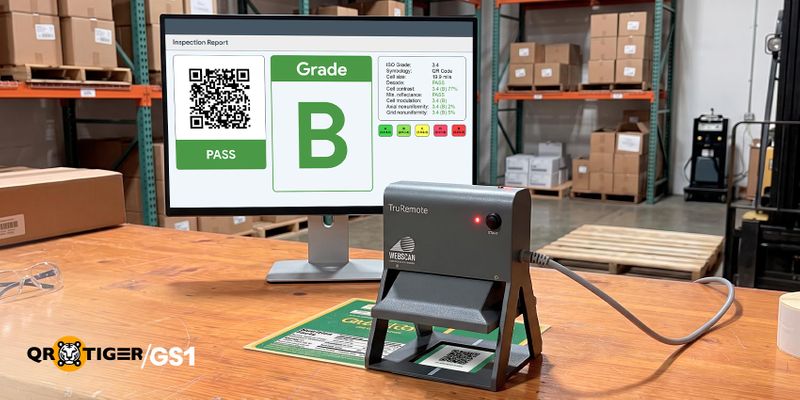
As retailers prepare for Sunrise 2027, barcode quality will remain an important part of vendor compliance. Poor-quality GS1 2D barcodes can cause the same scanning problems as 1D barcodes.
GS1 2D barcodes can store more than a product identifier. They can also include information such as batch numbers, expiration dates, and serial numbers, improving product traceability and customer engagement. During the transition, many products will carry both a 1D barcode and a GS1 2D barcode.
The healthcare industry already shows how important barcode quality is. Products using a GS1 DataMatrix commonly require a minimum barcode verification grade of C (1.5).
While healthcare handles barcode quality through regulatory compliance rather than chargebacks, it demonstrates that barcode verification is already an established requirement for 2D barcodes.
Many retailers already require suppliers to meet barcode quality requirements or provide barcode verification reports for 1D barcodes. As GS1 2D barcodes become more common, it is reasonable to expect similar quality requirements to ensure reliable scanning.
Barcode verification also gives businesses some design flexibility. A GS1 QR Code or Data Matrix can still achieve a passing grade when color is used correctly, and the barcode follows GS1 standards.
However, too many design changes, such as poor color contrast or oversized logos, can reduce scan performance and increase the risk of future compliance issues.

The Bottom Line: Compliance Drives Efficiency
Vendor chargebacks are simply a way for retailers to recover the costs of supplier noncompliance under the terms agreed in the MVA.
These requirements exist to keep products moving smoothly through the supply chain. When shipments arrive on time, are properly labeled, and meet the retailer's standards, stores can stock products faster, and customers are more likely to find what they need on the shelf.
While a chargeback helps retailers recover some of their costs, it does not recover lost sales or customer trust. Empty shelves, delayed deliveries, and receiving problems can still affect the shopping experience and hurt both the retailer and the supplier.
The best way to avoid these losses is to treat vendor compliance as part of your everyday operations. Following your retailer's requirements, checking barcode quality, and reviewing shipments before they leave your facility can help reduce chargebacks, protect your revenue, and build a stronger relationship with your retail partners.
Common Questions
What is a chargeback vs a refund?
A refund is money that the seller agrees to return to the customer.
A chargeback is a forced deduction triggered by a dispute or a compliance failure, not a voluntary decision by the party paying. There are two versions: Customer and Vendor/retail
Do chargebacks hurt a business?
Yes, vendor chargebacks reduce a supplier's revenue by deducting costs from payments. Repeated chargebacks can also lower supplier performance scores, strain retailer relationships, and increase the risk of rejected shipments or reduced business opportunities
Can you dispute a vendor chargeback/deduction?
Yes. Most retailers allow suppliers to dispute a vendor chargeback within a specified time. Depending on the retailer, this window may range from 15 to 90 days after the deduction or claim notice. Missing the deadline usually means the chargeback becomes final, regardless of the supporting evidence.
The process and required documents are usually described in the MVA or Vendor Compliance Manual. Suppliers should provide evidence, such as proof of delivery, shipping records, ASN confirmations, or barcode verification reports, to support their claim.
Are GS1 standards required to avoid vendor chargebacks?
It depends on the retailer's requirements. Retailers that use GS1 standards for POS scanning, inventory management, or supply chain operations may require suppliers to follow them as well.
Meeting these requirements helps prevent scanning issues and compliance problems that can lead to vendor chargebacks.

DISCLAIMER: We acknowledge that GS1, as well as the materials, proprietary items, and all related patents, copyright, trademark, and other intellectual property (collectively, “intellectual property”) relating to its use, are the property of GS1 Global, and that our use of the same shall be in accordance with the conditions provided by GS1 Global.
